People · 1950–2009
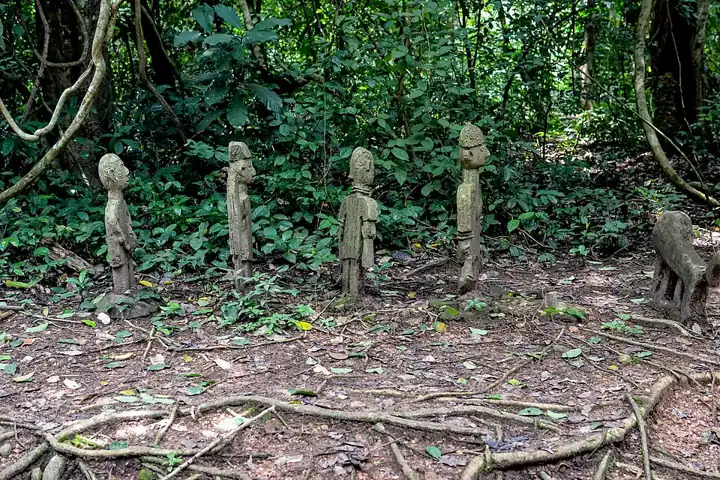
Image: Adunni Olorisha carvings at the Sacred Grove Of Oshun.jpg — Yeniajayiii, CC BY-SA 4.0 · source
A painter from Austria became a Yoruba priestess and filled the Osun grove with giant sculptures to protect it.
Susanne Wenger was born in Graz, Austria, in 1915. She trained as an artist in Graz and then in Vienna, and after the Second World War she was part of the young art crowd there, drawing strange, dreamlike pictures. In 1949 she went to Paris, and there she met Ulli Beier, a German who studied languages.
Not long after, Beier was offered a job as a phonetics teacher in Ibadan, Nigeria. Wikipedia says the post was only open to a married man, and the couple had hardly thought about marriage before, so they married in a hurry in London. The Guardian's obituary tells the best part. At the registry office they handed over curtain rings, and when the registrar told them a wedding was not a silly joke, they asked him how he knew.
Ibadan did not suit them. The new university sat on the edge of the city, and most of the British staff kept away from the African students. Wenger called it an artificial compound. So in about 1950 they moved to Ede, a Yoruba town nearby, and lived among ordinary people. She started working with adire, the indigo-dyed cloth of the area.
Then she fell badly ill with tuberculosis. Wikipedia puts this within a year of her arrival, while the BBC says it was during an epidemic in 1957 in which thousands died. A friend later told the BBC that she saw the illness as a kind of sacrifice, the price of the knowledge she was being given. Around this time she met Ajagemo, a priest of Obatala at Ede, and he became her teacher. She had no Yoruba and he had no English. "Our only intercourse was the language of the trees," she said years later. He led her into the world of the orisha, and she never came back out of it.
Wenger and Beier later divorced, and she married a local drummer. The Guardian calls him Chief Alarape and dates the wedding to 1959, while Wikipedia names him Lasisi Ayansola Onilu. She went through initiation into the worship of Obatala, of Soponna and of the Ogboni society, and she was given the title Adunni Olorisha. The trust that now looks after her legacy translates Adunni as "the one you like to have around you", and Olorisha as one who has been initiated to the orisha.
She settled in Osogbo, in a tall house on Ibokun Road that had first been rented for Beier. When she arrived is not settled. The BBC says 1957, the trust that runs the house says the late 1950s, and Wikipedia says 1961. The house filled up with carvings, metalwork and painted walls, and with children. The Guardian says she adopted more than a dozen Yoruba children, among them Nike Davies-Okundaye, who grew up to become a well-known artist herself.
One of them, Sangodare Gbadegesin Ajala, told the BBC a story that shows how fierce she could be. He came to her at eleven, the day he was initiated as a priest of Sango, and six months later he asked if he could go to school. She shouted no. In those days the schools were run by churches and mosques, and she believed they would turn him into a Christian and his old life would be over. He never learned to read, but he became the high priest of Sango and a well-known batik artist, and he worked in a studio on the ground floor of her house until he died in 2021.
When the BBC visited in 2008, she was bent over with age and could see with only one eye, but she still sat in an upstairs room full of carved gods, blessing visitors in fluent Yoruba.
Just outside Osogbo, along the winding Osun river, is a forest that belongs to the river goddess Osun. UNESCO describes it as one of the last pieces of untouched high forest in southern Nigeria. By the 1950s it was in trouble. Shrines were falling down, priests had drifted away, and people were fishing, hunting and cutting trees there, things the old rules had always forbidden.
According to Wikipedia, it was an Osun priestess who asked Wenger for help, worried about termites and commercial interests eating away at the shrines. Working with the Public Works Department and local artists, Wenger began rebuilding them in wood and cement. Over the years her circle of artists, who became known as the New Sacred Art movement, filled the grove with huge figures in cement, iron and mud. Some of the shrines, such as those for Alajere and Iyamoopo, rise about six metres high. UNESCO says the sculptures were not made to glorify the artists. Their giant size and frightening shapes were meant to make the grove feel holy again, so that nobody would dare to wreck it.
People still tried. The BBC reported that religious enemies tried to smash her sculptures and burn the forest. A former museum curator, Ajani Adigun Davies, remembered a man who bought part of the grove from a relative of a traditional ruler and brought a bulldozer to clear it for a house. Wenger lay down in front of the machine.
The grove was declared a national monument in 1965, and in 1992 the protection was widened to cover all seventy-five hectares. In 2005 UNESCO made it a World Heritage Site, and the same year Nigeria admitted her to the Order of the Federal Republic. Every August, thousands come for the Osun-Osogbo festival.
Wenger died in Osogbo on 12 January 2009, aged 93 by most accounts, though the BBC said 94. She was buried in secret in one of the grove's shrines, and journalists were kept out. Asked about her legacy, she had brushed it off. Osogbo was a creative place by itself, she said. It never needed her.