People · 1822–1910
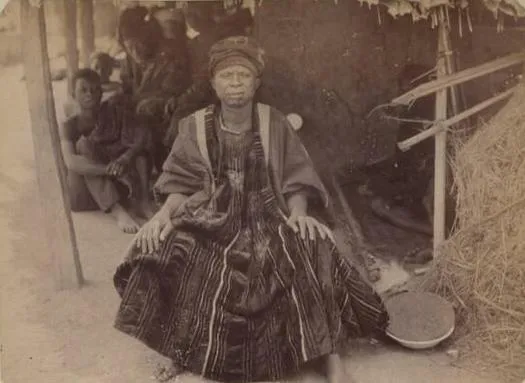
Image: Ogedengbe of Ilesa.jpg — Colonial Office photographic collection, The National Archives UK (CO 1069/80), Public domain (no known restrictions) · source
Captured twice, he escaped twice. Then he led the Ekiti and Ijesha against Ibadan, and even the British had to deal with him.
The story of Ogedengbe begins with a prophecy. In 1822, both Wikipedia and ASIRI Magazine say, a babalawo told the Owa of Ilesa that a boy would be born on an Isegun day, a day of victory, and that this child would one day free the Ijesha from their oppressors. ASIRI says the Owa sent servants out to the villages to watch, and that only one baby was born that day. He was named Orisarayibi Ogundamola, which Wikipedia explains as "the orisha provided this child" and "Ogun adds to wealth". His birth also fell close to the yearly festival of Ogun, the god of iron and war.
From here the two accounts part ways. Wikipedia says he was born in Atorin, his mother's small village near Ilesa, and that his mother died giving birth to him. ASIRI tells it differently. It says he was born in his father's house at Ijoka in Ilesa, carried to Atorin after his naming, and spoiled by both parents, so much that he was still breastfeeding at seven. Even his mother's name is not settled, Falupo in one account and Juola Orisatomi in the other.
The nickname that stuck, Ogedengbe, is explained two ways too. Wikipedia links it to his way of fighting, lifting enemies clean over his head. ASIRI links it to his hunger to lead. Later he earned a second name, Agbogungboro, which Wikipedia translates as one who craves war as others crave festivals.
ASIRI paints the young man as a rascal who called his parents by their first names and was rude to his elders. At seventeen he became deputy leader of the Ipaye, an age group of young men who repaired the palace, the markets and the roads and kept order in town. Around 1857, ASIRI says, he took a girl called Orisaleke from her parents' house after they refused to let her marry him, and the Owa sent him to prison for three months. It was a wild start for a man who would end up one of the most respected chiefs in Ijeshaland.
Ogedengbe grew up in the age of the Yoruba wars, when Ibadan was the great military power and the Ijesha and Ekiti towns were under its thumb. In 1864 he was captured while helping to defend Ilara against Ibadan. He escaped. In 1867 he was captured again during the Igbajo war. He escaped again. Wikipedia says that during his first captivity he was trained by an Ibadan warrior named Bada Aki-Iko, and both sources agree the two spells in enemy hands taught him how Ibadan thought and fought. It was the best military school he could have had, even if he never chose to attend it.
The legends gather thickest around these years. ASIRI tells how, at Igbajo, a young Ibadan soldier cut off Ogedengbe's head, and the general staggered, picked up his own head and fixed it back on. It also says the Ibadan general Ogunmola cut Ibadan tribal marks into his face, hoping someone would mistake him for an Ibadan man and kill him. Later, in the great war, people said he could sit in his house and fire arrows that landed on the battlefield, and that he could vanish when enemies came near. These are stories, but they tell you how frightened his enemies were.
He built his reputation as a hero at home as well. When an Ijesha chief called Odole was accused of leaking war secrets to Ibadan, Ogedengbe chased him out of Ilesa. In 1878 the Ekiti and Ijesha towns formed an alliance, the Ekitiparapo, to fight Ibadan, and the long war that followed is remembered as the Kiriji War. Ogedengbe was about to travel to Benin, Wikipedia says, when the war leaders begged him to lead their army. He agreed with some reluctance. When he reached the camp he was cheered, and Prince Fabunmi, who had been in command, stepped aside for him. Under him the alliance broke Ibadan's hold on the north-eastern Yoruba towns, and a peace treaty was signed in 1886.
Peace did not suit his war boys. After the treaty Ogedengbe pulled back with his men to Imesi, Wikipedia says, while ASIRI has him settling back in Ilesa. Both agree his men began raiding farms and seizing ordinary people. That brought him up against a new power. Captain Robert Lister Bower, the British Resident at Ibadan, warned him, and in 1894 Bower arrested him. He was held at Ibadan, and when Ilesa protested at that, Wikipedia says, he was moved to Iwo. The Owa of Ilesa, Frederick Haastrup, pleaded for him, and Governor Gilbert Carter of Lagos let him go after £6,000 was paid, an enormous sum in those days.
A photograph from this time is kept in the British Colonial Office collection at the National Archives in London. Its caption calls him "Seriki of Ilesha, recently arrested by Captain Bower". It shows him seated in a striped robe under a thatched shelter, with young men behind him. He does not look like a magician. He looks like a serious older man who had been at war most of his life.
In 1898 he was given the title Obanla of Ilesa, in honour of what he had done in the Kiriji War. Wikipedia adds that he turned down offers to become Owa, the king himself. ASIRI remembers his old age with a gentler story. Afraid of being poisoned, he would send a huge dog to market with cowries and samples tied round its neck. The market's head woman filled the bundle, and householders along the way had to greet the dog as it passed. When Ogedengbe died, the dog vanished.
He died in 1910, on 29 July according to Wikipedia, at about eighty-eight years old. Wikipedia says the colonial government commissioned a sculpture, the Ogedengbe Staff, in 1934 and placed it outside the Owa's palace. ASIRI notes a cenotaph at the Obokungbusi Town Hall, and both mention Ogedengbe Memorial School in Ilesa.