Legend · Legend; Baptist camp from the 1950s-60s
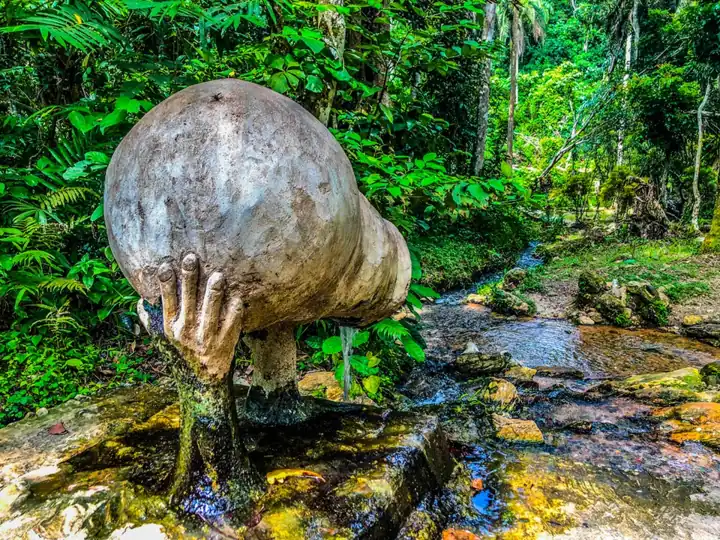
Image: Ikogosi warm spring 02.jpg — Hadassah Photostorie group, CC BY-SA 4.0 · source
In Ikogosi a warm spring and a cold spring flow side by side. The legend says they are a healer, his wives and his son.
In a green, hilly corner of Ekiti West, at the town of Ikogosi, there is a place where two kinds of water come out of the ground almost side by side. One spring is cold, like any stream you would find in a forest. The other is warm, about seventy degrees Celsius where it rises, hot enough to make you snatch your hand back. The two run on through the trees until they meet, and where they meet the water settles at about thirty-seven degrees, close to the heat of your own body. What amazes visitors most is that, for a stretch, each keeps its own temperature, flowing together without quite becoming one.
The guides who walk people round the springs will tell you there is more to it than two streams. One of them explained to a reporter from The Sun in 2025 that there are really four sources: two warm and two cold. There is a meeting point of warm and cold, a meeting point of cold and colder, and a meeting point of warm and warmer. Early in the morning, he said, the warm water steams, and the warm water runs clearer than the cold, which looks darker. Right beside the springs he pointed out a palm tree and a mahogany tree growing from the same root, which the guides like to call husband and wife.
People have long believed the water heals. The Ekiti State government's own write-up says it is thought to help with rheumatism, and the guides call the springs sacred. For a very long time, before any hotel or camp, the warm spring was a place of worship, and people of the town were afraid to go near its source at all. Those four waters and that fear are where the story of Ikogosi really begins, because the people did not see two streams. They saw a family.
The version told by the resort itself says the springs began with a man called Aopeere Ije. He was a hunter who came from Ile-Ife with his friends, liked the land for its palm wine, its farms and its game, and settled there. He was rich, tall and light-skinned, and he was also a healer who worked with herbs and with powers people did not fully understand. He married two women. The first, Awele, was calm and dark-skinned. When she could not have a child, she herself told him to marry again, and he married Orosun, a tall, fair and beautiful woman with a much hotter temper. For years neither wife had children, and yet together the three of them became known for helping barren women to conceive. At last both wives got pregnant, and a son, Olosun, and a daughter, Oora, were born.
When Aopeere Ije knew he was about to die, he chose to become a stream that would never stop flowing and would carry his healing power. He went into the ground, and warm water bubbled up. His family wept, so he came back and gave them the power to follow him if they wished. Olosun became a second, gentler warm spring beside his father, and the two wives became the cold and the colder springs. Oora, who by then was married in Ilesa, became the Oora stream that still flows there. In the resort's telling she quarrelled with her father, and he cut her leg in anger before she fled.
The guide who spoke to The Sun told the same family story with a few changes. In his version the springs were first found by a hunter named Ogaungaun, the healer was Awopeereije, and the second wife was Ainaorosun. A state government feature names the hunter Ogunkugan. TheCable heard yet another version, in which a farmer called Ogangan married two wives who fought with magic until they turned to water, and the hot-tempered one, Awele, became the warm spring. Every telling keeps the same heart, though: a family that loved each other enough to keep flowing side by side for ever.
The springs became famous because of a stranger who ignored the warnings. In 1952 John S. McGee, a Southern Baptist missionary based in the nearby town of Igede, heard about the springs and decided to walk to their source. People told him not to, because going there was believed to invite death. He went anyway, came back unharmed, and later wrote that he felt the place could be used for a good purpose. With Baptist churches in Ekiti, he built a youth camp there, with cabins, a chapel, a dining hall and a swimming pool fed by the warm water.
What happened next depends on who is telling it. Wikipedia's account, written from McGee's family's side, says that after the civil war people in Lagos began to spread rumours that the camp was a plot by the American CIA, and the famous writer and educator Tai Solarin criticised it in a newspaper. Then some old boys of the Baptist college at Iwo brought Solarin to meet McGee, who showed him a beaded walking stick given to him by the Ewi of Ado, and Solarin changed his mind on the spot. The Ekiti State government's feature tells it very differently. It says McGee refused Solarin and his Mayflower School students a room for the night, so they slept outside, and Solarin wrote an angry petition accusing him of apartheid, after which McGee was asked to leave. TheCable says the opposite again, that Solarin was the one who urged McGee to build the camp.
The ending, at least, is clear. The government took over the springs in the 1970s, McGee's family left Nigeria, and in 1978 the Baptists sold the whole property to the government for three hundred thousand naira. Today it is a resort with chalets, a spa and restaurants, one of them named Olosun after the son in the legend. You can still sit where the warm water meets the cold and choose which story to believe.