Lost history · 1824–1895
Image: 1894 Shitta.jpg — Unknown author, Public domain · source
A Saro trader born in Freetown grew rich on the Niger, built a mosque on Lagos Island, and got a title from the Ottoman Sultan, carried by a lawyer from Liverpool.
Mohammed Shitta was born in 1824 in Sierra Leone. Wikipedia gives the exact day as 19 December and the place as Waterloo, one of the villages the British set up outside Freetown for Africans they had taken off slave ships at sea. That is how his parents got there. They were Yoruba, called Oku or Aku in Sierra Leone, and they had been enslaved and put on a ship bound across the Atlantic. The British navy's anti-slavery squadron stopped that ship, and instead of the Americas they landed in Freetown, free but very far from home.
His father was a Muslim, and the family lived among the Oku Muslims of Freetown. As a child Shitta was baptised by Church Missionary Society missionaries and was known for a while as William Shitta. It didn't last. Both accounts I read say he went back to his father's faith, and he stayed a Muslim for the rest of his life.
In the 1840s many freed Yoruba people in Sierra Leone began sailing back towards the land their families had lost. In Lagos they were called Saro, from Sierra Leone, and returnees from Brazil were called Aguda or Amaro. The Shitta family left in 1844 and settled first at Badagry. They didn't stay. In 1852 the fight between Akitoye and Kosoko over the throne of Lagos spilled into Badagry and pushed them on again, this time to Lagos itself. Shitta was in his late twenties and he had arrived where he would spend the rest of his life.
In Lagos Shitta started small. He worked as an agent for European firms and then struck out on his own. The Saro had a real edge in trade. They spoke English as well as Yoruba, they were used to travelling, and they were happy to go deep inland to buy straight from the people who grew or gathered the goods. Shitta dealt in ivory, kola nuts, gum copal and other goods, and he set up a trading base at Egga, a busy market town on the bank of the River Niger far to the north. Wikipedia says that by 1881 he even owned a steamer to carry his goods down the river to the coast.
He became very rich. Lagos people called him Olowo Pupa, the man with red money, because of his gold cowries. He also became powerful. He was close to the Obas of Lagos and gave money and advice to Oyekan I, and Wikipedia says he paid to back Oyekan's bid for the throne. He gave freely to his faith too. He was a major donor when the Lagos Central Mosque was rebuilt in 1873, and he took the title of Seriki Musulumi, a leader of the Lagos Muslims.
Then in 1891 he started his own mosque on Martins Street, now called Martins Ereko Street, on Lagos Island. The man who drew it was João Baptista da Costa, one of the returnees from Brazil, and he was helped by a local builder named Sanusi Aka. That is why it doesn't look like a mosque in the north. It looks like the Brazilian style houses and churches that Aguda builders were putting up all over Lagos then, with a busy, decorated front, tall arches and round windows. Writers can't agree on the cost. Some say three thousand pounds and some say seven thousand. Either way it was a fortune, and the Turkish news agency Anadolu, writing in 2018, said it was counted at the time as the most modern and costliest religious building in British West Africa.
The mosque opened on 4 July 1894, and the guest list tells you a lot about Lagos at the time. The Governor of the colony, Sir Gilbert Carter, presided. Oba Oyekan was there, and so was Edward Wilmot Blyden, the famous writer and thinker. Christian Lagos came too: John Otunba Payne, the businessman Richard Beale Blaize and the sea captain James Pinson Labulo Davies. The guest who came furthest was Abdullah Quilliam, a lawyer from Liverpool who had become a Muslim and opened the first working mosque in Britain. He came on behalf of Abdul Hamid II, the Ottoman Sultan in Istanbul, and he carried a letter from the Sultan asking the Muslims of Lagos to take up Western schooling. At the ceremony Shitta was given the Ottoman Order of the Medjidie and the title of Bey. From then on he was Shitta-Bey. The Muslim Voice says Quilliam's visit stirred people so much that a Muslim group called Egbe Kila was formed after he left.
That same year Shitta-Bey was one of the leaders behind a petition asking the British to recognise Muslim law for Lagos Muslims in matters like marriage, divorce and inheritance. He didn't get to enjoy his title for long. He died of influenza on 4 July 1895, exactly one year after the opening. Anadolu says he was said to have visited Turkey to give thanks, but I couldn't find a second source for that. His family still hold the Seriki Musulumi title, and in 2013 the mosque became a national monument.
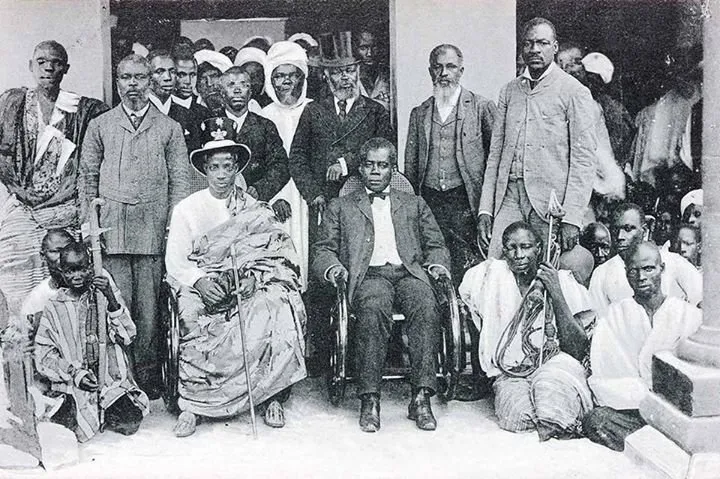
Now look at the photograph at the top of this page. It was taken at the opening in 1894 and is credited to the photographer Neils Walwin Holm. The archive caption names the people in it. The man seated on the left in the tall hat with a badge, holding a staff, is Oyekan, the Oba of Lagos. The man seated beside him in the dark suit is Dr Blyden. Standing behind them are Payne, Blaize, the consul J. S. Adelabu Leigh and Captain Davies. The governor isn't in this picture. These are the Lagos men, Christian and Muslim, who came out together that day for a Saro trader's mosque.