People · c.1835–1919 · Disputed
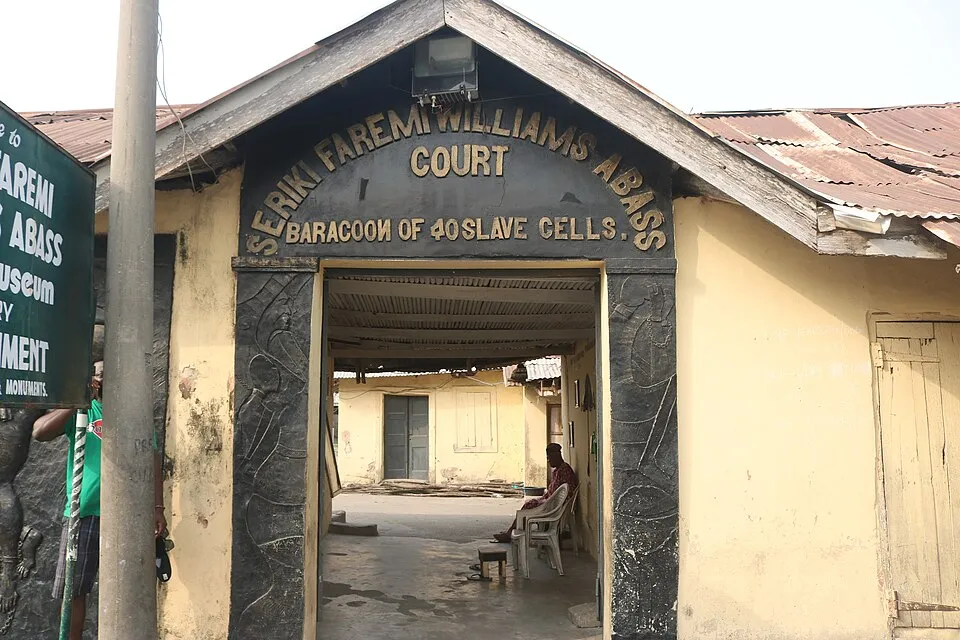
Image: Entrance of the Seriki Williams Abass museum in Mobee Badagry.jpg — Mrnyben1313, CC BY-SA 4.0 · source
A boy sold into slavery returned home and became one of the men who sold others. His story is one of Badagry's hardest lessons.
Seriki Williams Abass started life with a different name. His parents called him Ifaremi, or Ifaremilekun, and he was born in Joga-Orile, a town in the Ilaro district of what is now Ogun State. Wikipedia gives his birth year as around 1835. It was a frightening time to be a child in that part of Yorubaland. The historian O. Osho, writing about him in 2016, explains that the kingdom of Dahomey, to the west, ran much of its economy on the sale of captives, and its armies kept raiding Egba and Egbado towns, burning villages and carrying people off to be sold through the ports of Ouidah and Porto-Novo.
The boy was taken in one of those raids. A Dahomean slave dealer got him first. The sources do not agree on how he got the name Abass. Wikipedia says the dealer himself was called Abassa, while Osho says the dealer simply renamed him Abass. Then he was sold on to a Brazilian trader called Williams, and as was the custom with enslaved people, he was given his owner's name as well. A boy who began as Ifaremi had now been renamed twice by the people who bought and sold him.
Williams took him to Brazil and put him to work as a house slave. There, both main sources agree, his master taught him to speak and write English, Dutch, Portuguese and Spanish. For an enslaved boy that was an extraordinary thing to be given, and it set him apart. Williams saw something useful in him, a clever young man who knew the languages of the traders and also the land they bought captives from.
So he was sent back across the Atlantic, not as a free man going home, but as Williams's agent and business partner, with a job to do. He first settled at Ofin, in Isale-Eko on Lagos Island, and then moved west along the lagoon to Badagry. Osho notes that Badagry was not new to him. He had already done business around Porto-Novo and the Egbado country.
What he did in Badagry is the hardest part of this story. The boy who had been stolen went into the same trade that stole him. On the lagoon shore he kept a barracoon, a set of small cells where captives were held until they could be sold to European dealers and loaded onto ships. The word comes from the Spanish barracón, a rough hut or barrack. His had forty rooms. Osho writes that each room held as many as forty captives, and describes one cell whose only window, its only air, was no bigger than a computer screen.
The building still stands on Marina Road in Badagry, facing the water and the path towards the Point of No Return. Osho says it is the only one left of four such barracoons that once stood in different quarters of the town. It was built, he says, of burnt brick and corrugated iron brought in from Brazil. It is now the Seriki Williams Abass Slave Museum, and Wikipedia says it was declared a national monument in 2003. Inside, visitors see the cramped cells, heavy chains that once held people to the walls, and iron tools used to brand them.
But the dates do not quite add up, and it is fair to say so. The building is usually dated to around 1840, and both Wikipedia and Osho say he moved to Badagry in the 1830s. If he was really born around 1835, he would have been a small child then, not a slave dealer. Osho admits that no written record backs the 1840 date. Either his birth year is wrong, or the building is older than his time there, or the stories have been squeezed together. What nobody disputes is what the rooms were for.
As the Atlantic trade died away, Abass did not fade with it. He turned to legal trade with European firms. Osho names German and British companies he dealt with, including a weighing-machine maker in Birmingham. He also became a Muslim leader. He helped to renovate a mosque in 1877, and he was made Seriki Musulumi, chief of the Muslim faithful, in 1895 or 1897; Osho gives both years, and Wikipedia gives 1897. In 1899 he led a delegation asking the colonial government for a Muslim school in Badagry.
The British found him useful too. Osho says he was named Paramount Chief of the Badagry District in 1901, and both sources say that under indirect rule in 1913 he became Paramount Ruler of Badagry and the Western District. Wealth followed power. He is said to have married 128 wives and had 144 children, and Osho adds that only eleven of those children survived. In 1919 he bought the first lorry in the whole Egbado Division, the "Seriki Ford", to run on the Abeokuta to Ayetoro road. Osho credits him with helping to found Ayetoro and Idogo as safe places for people fleeing the wars, and says his statue now stands at a roundabout in Ayetoro.
He died on 11 June 1919 and was buried inside his own compound, among the cells. Osho points out how little has been written about him, almost as if people would rather forget. Badagry chose to keep the building instead. It tells a truth that is uncomfortable but important: the slave trade was not only the work of foreigners. Africans were drawn into it too, sometimes people who had once been its victims, and Seriki Abass was both.