Legend · Before 1500
Image: Moremi Statue I.jpg — BigDareLibrary, CC0 · source
Ife was losing to raiders who looked like spirits. One woman walked into their hands on purpose.
Long ago, the story goes, the people of Ile-Ife lived in fear of raiders. Again and again the attackers came out of the forest, year after year, dressed from head to foot in raffia palm and dry grass, with masks over their faces. They looted the market, carried off goods and dragged people away as slaves. They looked like nothing human. The people of Ife decided they must be spirits, ará ọ̀run, beings from the other world, and you cannot fight a spirit. So when the masked men came, Ife ran, and its homes were stripped.
The Ife people called the raiders the Ugbo, or in some retellings the Igbo, though historians agree they were not today's Igbo people. Some tellings say they were the forest people who had lived around Ife before the newcomers came, and who had been pushed out after a quarrel over the kingship. Every raid was their revenge.
The king at Ife, in many tellings, was Oranmiyan, son of Oduduwa. The raids wore him down until he could think of nothing else. His wife Moremi saw it. She was not from Ife at all. She came from the area of Offa, in what is now Kwara State, and she was known for her beauty and her nerve. One day she asked her husband what was troubling him. When he told her, she decided someone had to find out what the raiders really were.
Moremi went to the Esimirin, the river whose spirit the people of Ife honoured, and made a vow. Help me learn the raiders' secret, she said, and I will give you whatever you ask. The river agreed, at a price, and Moremi agreed without asking what the price would be. She imagined it would be a cow, perhaps, or a ram or a goat. That was what people usually gave a river.
Then she did something no one in Ife would have dared. The next time the masked raiders came, she did not run. She stayed where she was and let them take her.
They carried her back to their own town as a captive. She was so beautiful that their king wanted her the moment he saw her, and he married her. So Moremi became a queen in the enemy's house. She was calm and patient, and she kept her eyes and ears open. Slowly she learned what was under the raffia. The "spirits" were men, ordinary men in costumes of twigs, grass and dry palm fibre. And dry raffia catches fire.
When she had what she needed, she waited for her moment and slipped away. She went back to Ife and told her husband and the elders everything. Then they waited. When the raiders came again, the people of Ife met them with burning torches. The costumes went up in flames, and the men inside them ran or burned. After years of running, Ife won.
Oranmiyan took Moremi back as his queen. But she still owed the river.
When Moremi went back to the Esimirin to give thanks and pay what she had promised, the river told her what it wanted. It was not a cow or a ram. It wanted her only son, Oluorogbo.
She begged the river to take something else, anything less terrible. It would not. In the end Moremi kept her word, and gave her son. The story says all of Ife grieved with her. The boy was given up so that the whole town could be safe.
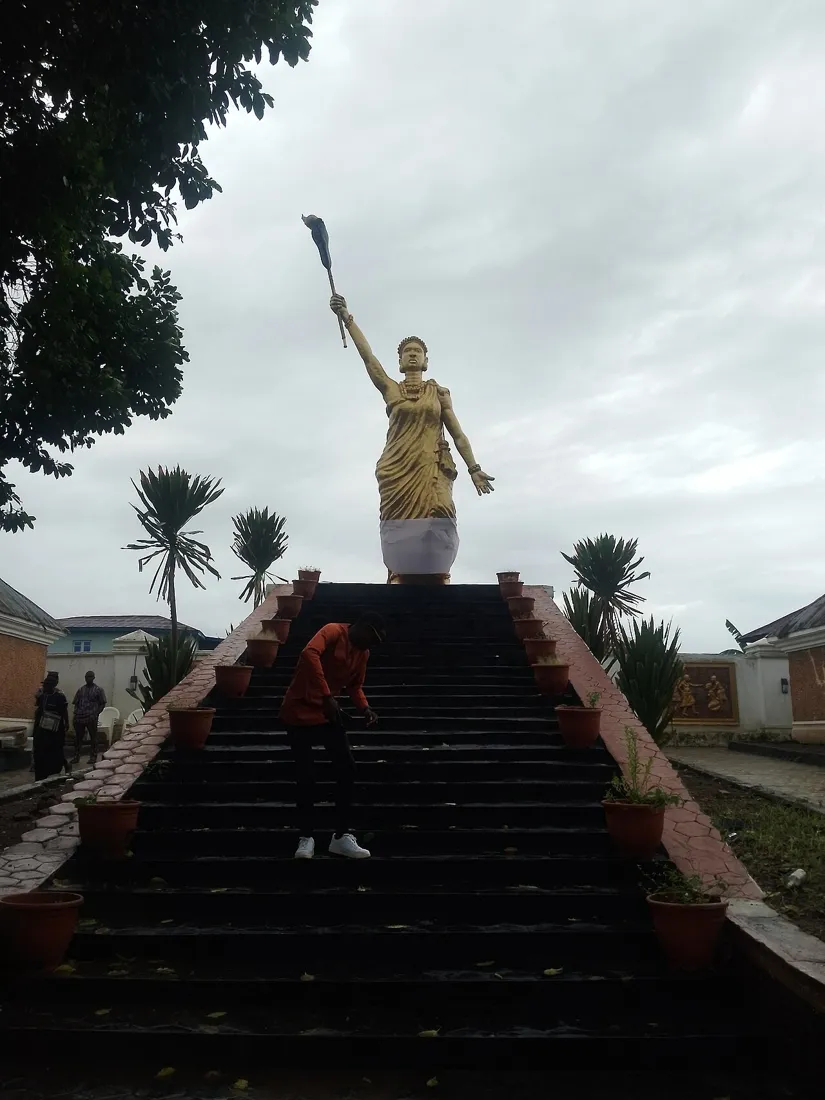
Ife has never stopped telling the story. The Edi festival began, tradition says, soon after Moremi's death, as the town's way of remembering what she did and what it cost her. It is held every year and celebrated as Ife's own independence day. In November 2017, at the Ooni's palace, Ooni Adeyeye Enitan Ogunwusi led a crowd with drums and singing from the palace hall to her statue for a ceremonial lighting. As the light came up, the crowd roared, as if the old enemy had just been beaten again.
The statue stands in the palace grounds, a woman many metres tall holding a burning torch. When it went up it was described as the tallest statue in Nigeria. Moremi's name is all over the country: on Moremi High School, and on the women's halls of residence at the University of Lagos and Obafemi Awolowo University in Ife itself.
None of it is history in the written sense. Moremi is known from oral tradition and from Ifa verses, and no one can put a date on her life. Even the tellings disagree about whom she married and who the raiders were. But the story Ife keeps is clear. Fear was the raiders' best weapon, a costume and a belief, and it took one woman going right into their camp to find out what they really were.