People · 1500s · Disputed
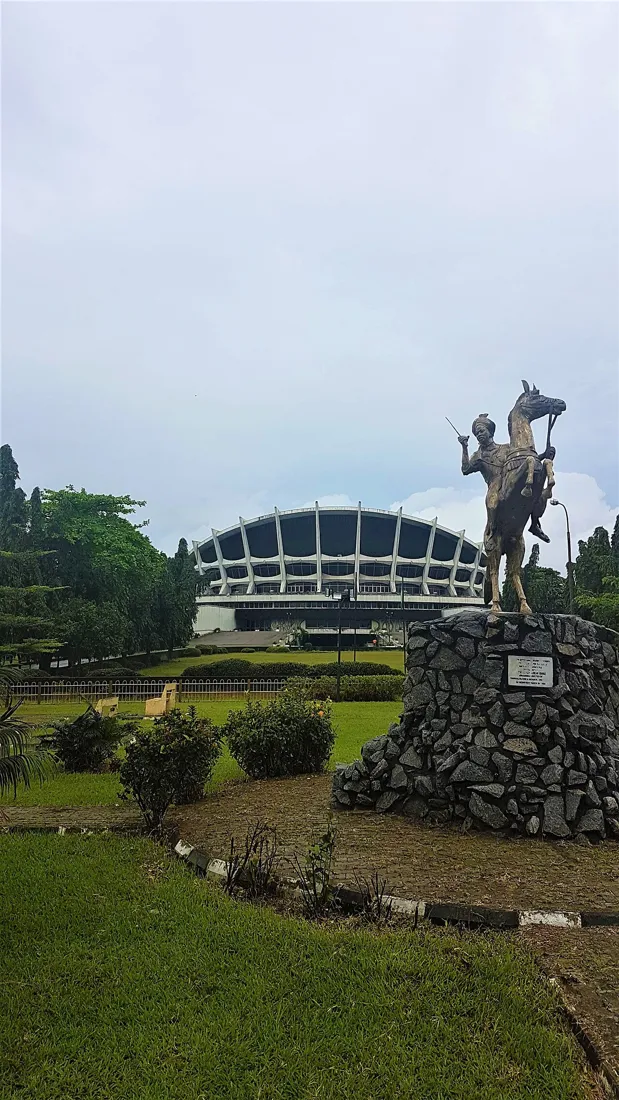
Image: Queen Amina Statue.jpg — Sidhant Bendre, CC BY-SA 4.0 · source
A warrior queen of Zazzau whose walls, the story says, still mark the land of northern Nigeria.
In the 1500s, the Hausa city-state of Zazzau, around modern Zaria in Kaduna State, was one of the seven original Hausa states, the Hausa Bakwai. The others were Daura, Kano, Gobir, Katsina, Rano and Garun Gabas. Zazzau was already one of the biggest of them. It sat on routes where goods from the desert met goods from the forest, and it grew rich on that trade. It also grew rich selling captives, who were taken north to the slave markets of Kano and Katsina.
Tradition says Amina was born there in the middle of the century, a daughter of Bakwa Turunku, who ruled Zazzau herself. In the oral legends collected by the anthropologist David E. Jones, the girl grew up in her grandfather's court and was his favourite. He carried her about with him and taught her politics and war while the other children played.
At sixteen she was named Magajiya, heir apparent, and given forty slave women of her own. Suitors came at once. One great man offered ten slaves a day for her. The ruler of Kano is said to have sent fifty male slaves, fifty female slaves and fifty bags of white and blue cloth. She turned them all down.
Around 1566 her parents died and her brother Karama became king. By then Amina was no longer only a princess. She rode as a leading warrior in her brother's cavalry, and men talked about her. Hausa praise singers still call her "Amina daughter of Nikatau, a woman as capable as a man."
Karama died in 1576, and some traditions say Amina then took the throne as sarauniya, queen. The story says one of her first orders was for her people to sharpen their weapons again. Three months after she was crowned, the wars began, and they did not stop for thirty-four years.
She could not go north, because Kano and Katsina were in the way, or east, where the Jos Plateau rose. So she turned south-east and south-west. The tradition gives her twenty thousand foot soldiers and a thousand horsemen, and has her taking land as far as Kwararafa and Nupe, with Bauchi and Yauri along the way. From Nupe she took tribute, and the Chronicle of Abuja says it came to forty eunuchs and ten thousand kola nuts. The story goes that this was how kola first came into Hausaland. Conquered towns were either taken into Zazzau or made to pay tribute every year.
In 1812, two centuries later, Muhammad Bello of Sokoto still found her astonishing. "Strange things have happened in the history of the seven Hausa States," he wrote in Infaq al-Maysur, "and most strange of these is the extent of the possessions which God gave to Aminatu." He claimed that the men of Katsina and Kano brought her tribute, and that her lands ran down to the Niger. Historians today doubt the part about Kano and Katsina.
Nobody knows for certain how she died. The nineteenth-century scholar Dan Tafa wrote that she died at a place called Attaagar, which later writers took to be near Idah, south of the Niger-Benue confluence. In one version she fell there in battle and her body was never found. Others put her death near Vom, on the Jos Plateau. On one thing the tellings do agree. She spent almost all of her reign at war, and by the usual count that reign lasted thirty-four years, from the death of her brother until her own.
Above all, Amina is remembered for her walls. The tradition says that to mark and protect the land she won, she had her towns ringed with earthen walls, and wherever her army camped, a wall went up. The practice spread across the region and lasted until the British took Zazzau in 1904. Old earthworks around northern towns are still called ganuwar Amina, Amina's walls. Whether she built every one of them is very doubtful. That so many carry her name shows how large she grew in memory.
Later writers added darker tales. Legends repeated by the colonial historian S. J. Hogben say she took a lover in every town she conquered and had him beheaded in the morning, "so that none should live to tell the tale." You will find that story everywhere online. It comes from much later writing, not from anyone who knew her.
The harder truth is that Amina is not on the Zaria chronicle's list of rulers at all, nor on the lists in the Chronicle of Abuja. Some traditions remember her as a gimbiya, a warrior princess, who never wore the crown. The Kano Chronicle puts her two centuries earlier, in the 1400s. Some scholars follow it, others prefer the 1500s, and the historian Abdullahi Smith dates her reign to after 1576.
None of that has dimmed her. Today her statue on horseback stands at the National Theatre in Lagos, and girls across Nigeria grow up hearing her name.