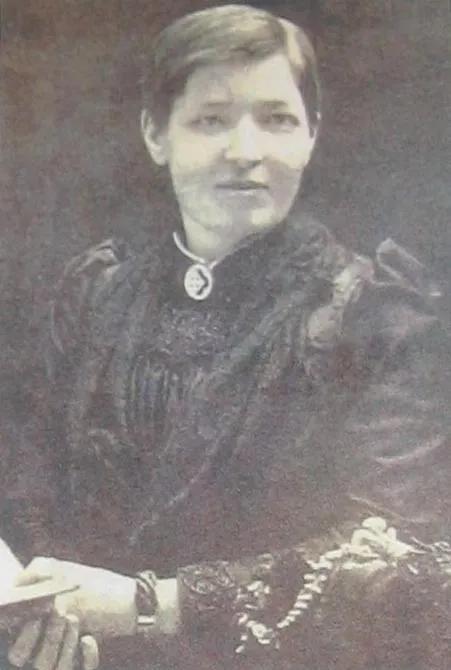
People · 1876–1915
Image: Mary Slessor.jpg — unknown, Public domain · source
A Scottish mill girl spent forty years in Calabar and became the guardian of babies others had been taught to fear.
Mary Slessor was born poor in Aberdeen in 1848, the second of seven children. When she was ten, her family moved to Dundee to look for work. Her father was a shoemaker who drank, and he could not hold a job for long. Her mother was a skilled weaver, and she kept the family going by working in the jute mills. At eleven Mary joined her as a "half-timer" at the Baxter Brothers' mill, spending half of each day in the mill school and the other half at the looms. By fourteen she was a skilled jute worker, on her feet from six in the morning to six at night. The family lived in the slums. Her father and both her brothers died, which left Mary, her mother and two sisters.
Her mother was a devout Presbyterian who read every issue of the church's missionary magazine, and Mary grew up on its stories of Calabar, the mission the Scottish church ran in southeastern Nigeria. She taught at a mission in the Dundee slums. Then she applied to go abroad herself. After training in Edinburgh she sailed in August 1876, aged 27, and landed that September at Duke Town, the mission's headquarters on the Calabar River.
For her first years she did what a junior "female agent" was expected to do. She taught, handed out medicines and went round the women's yards of Duke Town, Old Town and Creek Town. She learned Efik and spoke it so well that visiting mission inspectors said the people trusted her and listened to her. She was often ill. Malaria sent her home to Scotland more than once, and the fevers would come back for the rest of her life. But every time she returned to Calabar, she wanted to go further inland, to places other missionaries had not reached.
The thing she became famous for started with a belief she was warned about as soon as she arrived. In many communities around Calabar, a birth of twins was seen as a terrible curse. People feared that one of the babies had been fathered by an evil spirit, and since no one could tell which, both were often left in the bush to die, sometimes in clay pots. The mother could be driven out as well.
In Calabar itself, missionaries and the Efik king Eyo Honesty II had already put an end to most of this. Inland it went on. Slessor began taking in babies others had abandoned. One of the first was a girl whose twin brother did not survive. Slessor raised her as her daughter and called her Janie, and Janie stayed with her for the rest of her life and travelled with her to Scotland. After that, Slessor's house was never without babies. She adopted child after child and raised a whole household of her own.
In August 1888 she went alone to Okoyong, the country between the Cross and Calabar rivers. It had a fearsome reputation among missionaries, and the mission committee had hesitated for a long time before letting a single woman go. She thought a woman would seem less of a threat than a man. She lived there for fifteen years, in a local house, eating local food, settling arguments and setting up schools and trade. Her habit of living alone in remote places often got her into trouble with the authorities, and some people thought her eccentric. People in Calabar called her Eka Kpukpro Owo, mother of all.
Her real power came from trust. People in Okoyong brought their quarrels to her long before the British gave her any official title. In 1892 the British consul general made it official and appointed her vice-consul for Okoyong, presiding over the native court. She had argued that the people were not ready for a British court, and since she was already doing the job, the job was handed to her. In 1905 she was made vice-president of the native court at Ikot Obong, which made her one of the first women magistrates in the British Empire. People who came before her said she was quick, fair and not always conventional.
She kept going even when her body would not. By her last years the fevers had weakened her so much that she could no longer walk long distances in the forest. She never retired to Scotland. In January 1915, at her station near Use Ikot Oku, she had another bad fever, and she died on 13 January. She is buried in Calabar.
Her name is everywhere there today: a road, a roundabout, statues of a woman carrying twins. In Scotland her face was on the back of a Clydesdale Bank ten-pound note, beside a map of Calabar. But the story is more complicated than the statues. The end of twin-killing came from Efik rulers, local converts and families too, not one missionary on her own. And she worked inside a colonial and missionary system that many Nigerians look back on critically. The babies she raised are part of that history as well.