Place name · Left Ngazargamu 1770; emirate 1777 · Disputed
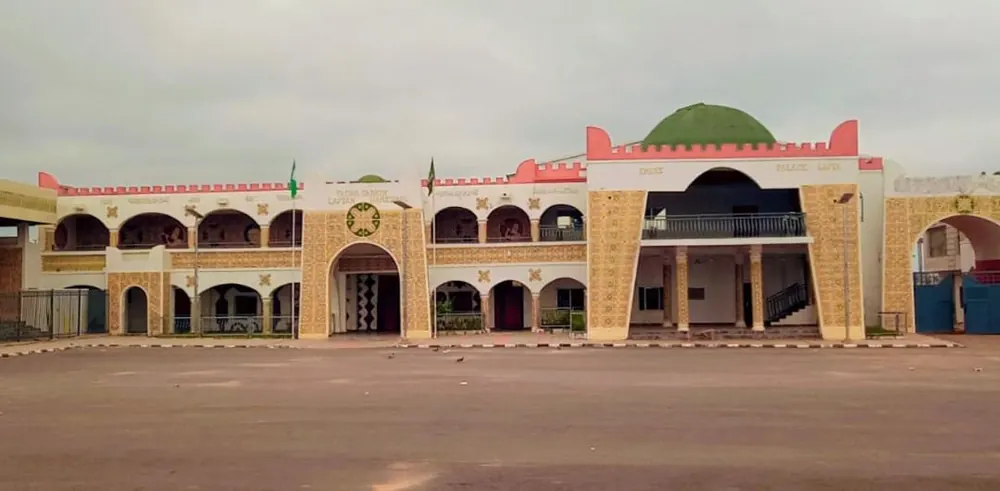
Image: Emirlafia.jpg — Lafia, CC BY-SA 4.0 · source
A Borno prince lost a bitter succession fight and walked away with his followers. Years later they settled far to the south, and two kingdoms still claim the right to have named the place.
In the second half of the eighteenth century, the old empire of Kanem-Borno was in trouble. It had lasted for something like a thousand years under the Sayfawa kings, and at its height it reached from southern Libya across eastern Niger to north-eastern Nigeria and the tip of Cameroon. Its capital was Birni Ngazargamu, a great walled city near the river Yobe. But by the last quarter of the 1700s, as the columnist Adamu Adamu put it in Daily Trust, its power was waning, and every change of ruler brought a bitter fight inside the royal family. Party after party of Kanuri, losers in these quarrels, packed up and left.
One of these losers was a prince named Dunama. Daily Trust describes him as the son of Mai Ali bin Hajj Dunama, and says that after one particularly nasty succession he left Ngazargamu with a band of followers in 1770. It is worth pausing on what that meant. A prince who loses a succession fight in a royal capital is not safe. Staying could mean prison or death. Leaving meant giving up his home, his rank and almost everything familiar, and taking with him only the people loyal enough to follow.
The route they took is remembered in some detail. They went west first, through Hadejia and on to Kano. Then they turned south to Zaria, which was already deep into Hausa country. They kept moving. They stopped for short stays in Gwandara country, at Shendam on the southern edge of the Jos Plateau, and among the Kwararafa, the old Jukun-led power of the Benue valley. Every stop was somebody else's land, and none of them became home. Finally they reached the place where Lafia stands today, south of the Plateau and not far from the Benue, about as far from Ngazargamu as a Kanuri prince could get and still be in what is now Nigeria.
Arriving was not the same as belonging. The land around Lafia was not empty. It was part of a world of established kingdoms, and a band of tired foreigners with a prince at its head would have to win acceptance before it could stay. Both of our sources agree on that much, even though they tell the rest of the story from opposite ends.
The Kanuri side of the story, as Daily Trust tells it, stresses alliance and courage. Dunama struck an alliance with the Aku Uka of Wukari, the king of the Jukun, who was the great power of the region. He showed what Adamu Adamu called Kanuri manliness, proved himself, and was finally accepted as lord of the area. He settled his people in what became the southernmost Kanuri settlement in Nigeria. The town was once called Lafiar Barebari, Barebari being the Hausa name for Kanuri people. Daily Trust dates the emirate to 1777, which would make it older than the Sokoto Caliphate, and says the town itself was founded in the very year the jihad began, which was 1804.
The Alago people of nearby Doma tell it differently, and they have it written down. Their traditional council compiled a book called Highlights on the History of Doma, summarised in 2025 by the journalist Matthew Eloyi. In that account the key figure is the Doma king, Andoma Oboshi Oga, who ruled in the late eighteenth century. A group led by a man named Dunama came to him looking for a safe place to live. Instead of sending them away, he let them settle within his domain and told them to live peacefully among his people.
Both stories end in the same word, and both claim it. Lafia means peace, or well-being, in Hausa. The question is who said it first.
In the Doma version, the Andoma's actual words to Dunama's people were "Ku tafi ku zauna lapiya," which the book translates as "go and settle in peace." The settlement, it says, came to be called simply Lapiya, and over time the word became Lafia. On this reading, the capital of Nasarawa State carries the blessing of an Alago king in its name. Doma is only about 24 kilometres away, so the claim is not far-fetched geographically.
Daily Trust points to a different blessing. In praising the emir of Lafia, Adamu Adamu ended with the line "Lafia ta zauna lafiya, just as Sarkin Kwandiri prayed," meaning roughly "may Lafia live in peace." The column does not explain who Sarkin Kwandiri was or exactly when he prayed, so that version is thinner, but it plainly ties the name to a prayer for peace from someone other than the Andoma.
Then there are the dates. Daily Trust gives 1770 for the departure and 1777 for the emirate, and also says the band had been wandering for more than three decades by the time Lafia town was founded. Those figures do not sit together neatly, and the Doma account sets the welcome loosely in the late 1700s, around the time of the 1804 jihad. The honest answer is that the exact years are uncertain.
What is not in doubt is the shape of it. A defeated Borno prince walked hundreds of kilometres with his people, was taken in by the kingdoms of the Benue country, and founded a town whose very name is about peace. Daily Trust argued in 2014 that Lafia had stayed one of the calmest places in the region, sitting between the Sokoto Caliphate, the Middle Belt and old Borno. When Daily Trust wrote that, the emir was Agwai I, who came to the throne in 1974 and was marking forty years on it. The columnist called Dunama his great-grandfather.