People · 1830s–1862 · Disputed
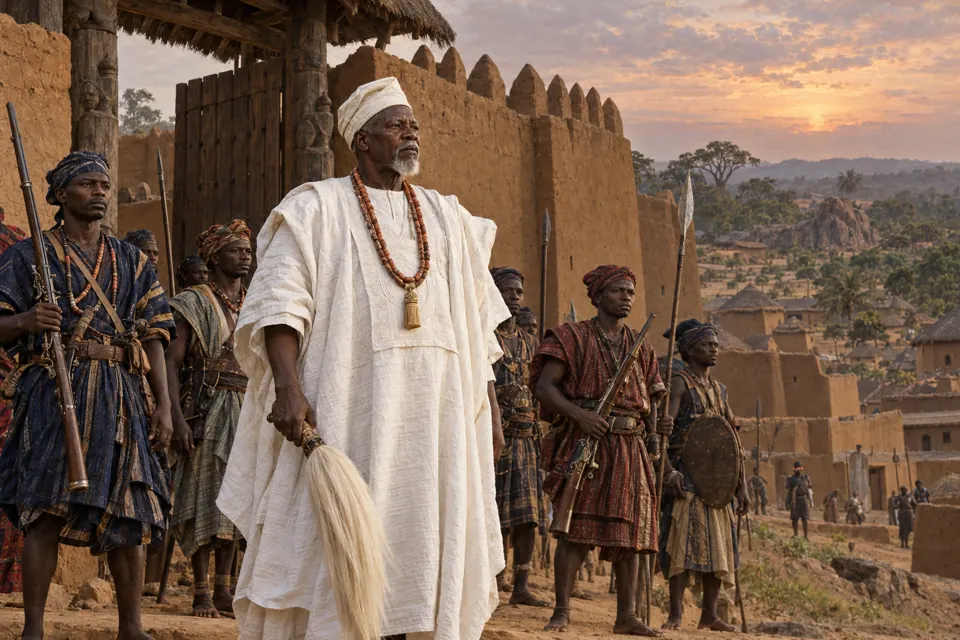
Image: Generated illustration — AI-generated with Codex image tool for Naija Tales, Generated — not a historical image
An old custom said the crown prince must die with his father. When Oyo broke it, Kurunmi went to war, and lost everything.
About eighteen miles north of Ibadan, in what is now Akinyele, there is a small farming town called Orile Ijaiye. Not much there tells you that it was once one of the most powerful places in Yorubaland, but it was, and the man who made it so was Kurunmi.
His story starts with a disaster. In the early 1830s, Old Oyo was overrun from Ilorin and its capital abandoned, and refugees and soldiers streamed south. Wikipedia's history of the town says a band of Oyo warriors, Kurunmi among them, seized Ijaiye from its Egba owners in 1833 and settled there. When a rival chief called Dado began causing trouble, Kurunmi drove him out, and later had him killed. By 1837 a new Alaafin, Atiba, had set up a new Oyo, and he gave Kurunmi the highest war title in the kingdom, Are Ona Kakanfo, the field marshal. By custom the Kakanfo could not live in the capital, so Kurunmi ruled from Ijaiye.
The town grew fast. Wikipedia records two missionary guesses about its size. Henry Townsend, who visited in 1852, thought it held about 40,000 people and said its market was the best he had seen in Africa. R. H. Stone, who lived there from 1859, guessed 100,000. Stone called Kurunmi "haughty, despotic, ambitious and cruel", but also "firm, just and reasonable on most occasions". Townsend noticed that while Kurunmi spoke against theft and kidnapping, his armed men forced trade caravans through the town so he could take 200 cowries a load. He was a hard man with a sharp eye for money.
In 1854 he let a Baptist missionary, Thomas Bowen, begin work in Ijaiye. A monument to Bowen still stands at the gate of Ijaiye High School, next to one for Kurunmi himself, though The Nation found in 2013 that the words on both had nearly faded away.
Old Oyo had a hard rule. When the Alaafin died, his eldest son, the Aremo, who had shared his father's power, had to die with him. Before Atiba died in 1859, he told his chiefs to set that custom aside and crown his son Adelu. Ibadan agreed. Kurunmi did not. To him the custom was the constitution, and it had been broken. He refused to attend the crowning or pay homage to the new king. Wikipedia adds that Ibadan had grown into a military giant by then, and that its leaders had turned cold towards the old general, so pride and power were mixed in with principle.
The quarrel soon turned into blood. A rich woman in Ijanna, a town under Ijaiye, died with no heirs. By custom her property went to the Alaafin, so Adelu sent men to collect it. Kurunmi's men attacked them at a place called Jabata. Wikipedia says he took 240 captives and made Adelu pay double to get them back. Chiefs from Ibadan and elsewhere begged him to make peace. He would not.
What happened next is told in different ways. Wikipedia says Adelu sent messengers carrying an Ogboni symbol, meaning peace, and gunpowder, meaning war, and asked Kurunmi to choose. Kurunmi killed all but one messenger and sent the peace symbol back. Pa Layiwola Adio, a grandson of the general who was more than a hundred years old when The Nation met him in 2013, remembered the same idea more simply: Adelu sent word asking him to choose peace or war, and he chose war. Another version told to The Nation swaps the king for the missionary, with Kurunmi holding gunpowder and Bowen a Bible. In 1860 Ibadan declared war on Ijaiye.
Ijaiye did not fight alone. The Egba and the Ijebu joined it, because they feared Ibadan too. Ibadan, led by its war chiefs Ibikunle and Ogunmola, camped by the River Ose. There was an old grudge between Ogunmola and Kurunmi. Both Wikipedia and the people of Ijaiye say Ogunmola had once been Kurunmi's prisoner and was fed on ashes, and Ibadan still praises him as the son who ate ashes and did not die.
Wikipedia tells how Ibadan copied the drum signals Ijaiye's army used, and used them to draw Kurunmi's men across the river into an ambush. His eldest son, Arawole, was killed, and his head was sent to his father. In the end all five of his sons died. The Egba pulled back without warning him, Ibadan cut off the farms that fed the town, and Ijaiye began to starve. People in Ijaiye today say that more than 141 towns stood with Ibadan.
Kurunmi died in 1861, before the end. How, nobody agrees. Some say he took poison when his sons were gone. Pa Adio said he died at home and was buried beside the Ose with three slaves, as custom demanded. Others say he fell in battle. One local account says only his daughter Iyagbogbo knew where he lay, but Wikipedia's town history says his head slave, Abogunrin, buried him in secret, and that when the grave was found his head was taken to Adelu. Ijaiye fell on 17 March 1862 and was destroyed. According to that town history, survivors returned to build Orile Ijaiye only in 1895, and the play Kurunmi by Ola Rotimi made sure he would not be forgotten.