Lost history · 1903–2016 · Disputed
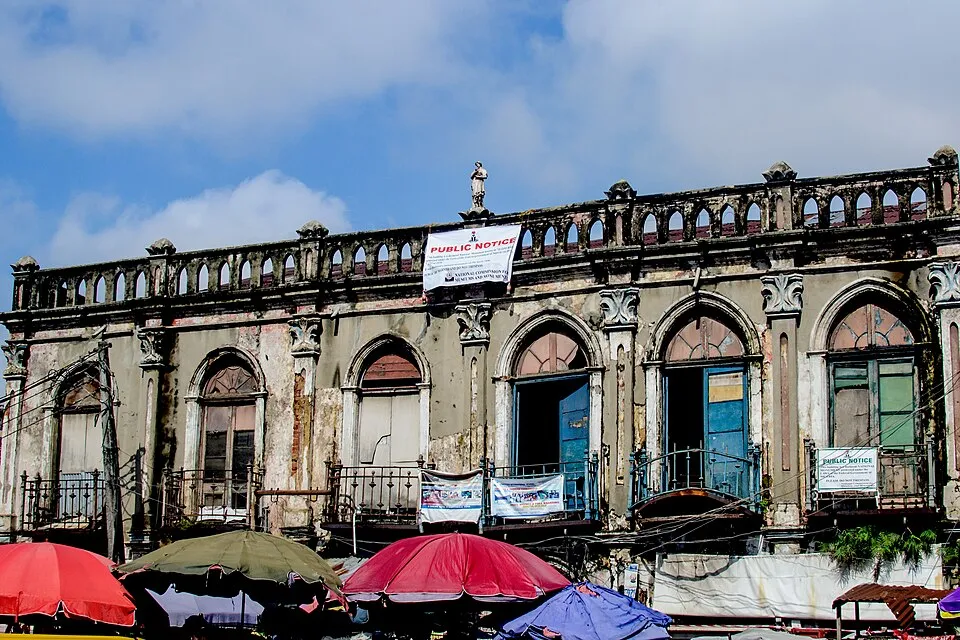
Image: Ilojo bar.jpg — Epicy, CC BY-SA 4.0 · source
For years Lagos was told this lovely old house dated from 1855. A patient researcher found out the truth, after the house was already gone.
If you crossed Tinubu Square on Lagos Island before 2016, you probably saw it. It was a tired, beautiful two-storey house on the corner of Bamgbose Street, with arched windows, carved plaster around the doors and a long balcony looking over the square. Most Lagosians called it Ilojo Bar. Some knew it as Olaiya House. Older papers called it Casa do Fernandez. Guides would tell you it was one of the finest examples of the Brazilian style in the city.
That style has a story of its own. In the nineteenth century, Africans who had been enslaved in Brazil and Cuba, and their children, came back across the Atlantic and settled in Lagos. People called them Aguda. Many were skilled builders and craftsmen, and they put up brick houses with arches, wooden shutters and plaster decoration in the streets around Campos, the Brazilian quarter. Ilojo Bar became the best-known of them, and it was at the centre of the community's social life.
The story everyone repeated went like this. A family called Fernandez built the house in 1855 as a bar and restaurant, using the skills of returnee builders. It was so admired that in 1956 the National Commission for Museums and Monuments declared it a national monument, one of the earliest in Nigeria. In 1933 a businessman from Ijesa land, Alfred Omolana Olaiya, bought it. He named it after his home town, Ilojo, and ran a bar there, and the name stuck so well that most people never knew the house had been called anything else. Olaiya came from the family that would later give Nigeria the highlife bandleader Victor Olaiya.
Then someone went and checked. In 2021 a Dutch journalist, Femke van Zeijl, wrote a master's thesis at Leiden University called The Curious Case of Casa do Fernandez. She went through old land papers, newspapers and photographs. What she found did not match the famous story.
The house was not one house at all. It was two, joined together, and both halves were built much later than 1855, somewhere between 1903 and 1914. The right half, slightly narrower, belonged to a trader named José Amoedo Fernandez. He was from Galicia in Spain, and he had never been a slave in Brazil or anywhere else. The left half, a little wider, the part that later became the bar, first belonged to another man, Vicente Guedes. Fernandez bought that half in 1903 and remodelled it to match his own. In 1914 he sold the whole building to Napoleon Rey Couto.
So the date was wrong, and the founding family was not who people thought. The house was real, and it was lovely, but its owners had been a Spanish trader, a man with a Portuguese name and then a Yoruba businessman. That mix is very Lagos. The city has always been a place where traders from many countries met, argued, built and sold to one another. The 1855 story seems to have grown up later, passed from one telling to the next until it was printed as fact. Even the newspapers that reported the house's death called it "161 years old."
By then the house was in bad shape. It was a national monument, but the Olaiya family was still allowed to live in it, and they said the walls had cracked and the roof was falling in. Their lawyer said they had written to the Commission for Museums and Monuments again and again asking for repairs that never came.
On Sunday 11 September 2016, during the Eid holiday weekend, a demolition crew came at night. Hoodlums surrounded the site while the building was pulled down. By Monday the house on Tinubu Square was a pile of brick and rubble. A man at the scene said the family had hired him and that he had permission. The family later said a state building agency had judged the house unsafe and told them to bring it down.
The Lagos State Government said the opposite. Its planning officials called the demolition illegal, took over the site, declared it a no-go area and threatened to prosecute whoever was behind it. According to the officials, the developers had already started building on the cleared ground before the state stepped in. The matter was investigated, and the land stayed under state control. Heritage campaigners called it a national loss.
So Lagos lost the house twice. It lost the walls in 2016. And because Femke van Zeijl's research came five years later, it also lost the story it had been telling about them. What survived is a truer and stranger history than the one on the guides' lips. Today, if you stand on Tinubu Square, there is no trace of the house. The photo on this page was taken on 7 September 2016, four days before it came down. Pictures like it are almost all that remain.