Lost history · 9th–10th century; found 1938
Image: Generated illustration — AI-generated for Naija Tales, reviewed for accuracy, Generated illustration, not a historical photo
In 1938 a farmer digging in his compound hit metal. He had found some of the finest bronze casting in the medieval world.
In 1938 a man named Isaiah Anozie was digging in his compound at Igbo-Ukwu, a town in what is now Aguata, Anambra State. He was working on a water cistern, the sort of practical job people do in a place where groundwater is scarce, and Igbo-Ukwu sits on a dry sandstone ridge. His spade struck metal.
What came out of the ground were bronze objects, beautifully made and strange. Anozie had no way of knowing what they were. So he did what anyone might. He gave some away to friends and neighbours. And some of the vessels he kept for a very ordinary use. He watered his goats from them.
I love that detail, because of what those vessels turned out to be. Months later the British district officer for the area, J. O. Field, heard about the finds. He bought many of them and wrote them up in an anthropological journal. In 1946 he handed them to the Nigerian Department of Antiquities. Five objects from that first discovery are now in the British Museum in London: a small staff, a ram's head, a large manilla, a finely worked crescent-shaped vessel, and a little pendant in the shape of a chief's head, its face marked with the ichi scars that titled Igbo men once wore. In 1954 Kenneth Murray, the Surveyor of Antiquities, collected further bronzes from Anozie's compound.
Then the archaeologists came. Between 1959 and 1964 Thurstan Shaw, working with the Department of Antiquities and the University of Ibadan, excavated three areas. They were named after the men on whose land they lay: Igbo Isaiah, around Anozie's original find, Igbo Richard and Igbo Jonah.
What Shaw found shook the art world. Altogether the sites gave up more than 700 objects of copper, bronze and iron, and around 165,000 beads of glass, carnelian and stone. There were ritual vessels, pendants, crowns, breastplates, staff ornaments, swords and handles for fly whisks.
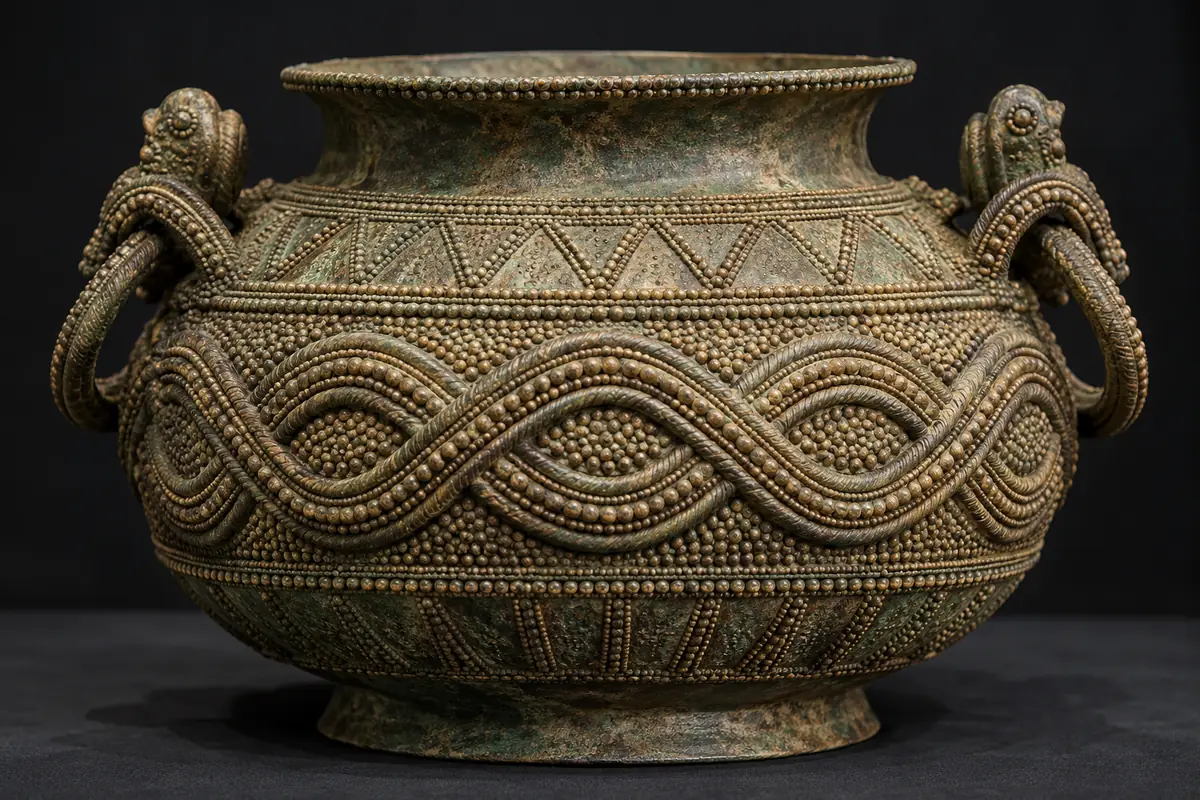
The workmanship was astonishing. One piece, a water pot cast as if it were tied up in a net of rope, has been called a virtuoso feat of lost-wax casting, more advanced than anything being cast in Europe at the time. Art historians reached for the most famous European names they could think of. They compared the bronzes to Fabergé's jewellery and to the work of the Renaissance goldsmith Benvenuto Cellini, who lived about five hundred years later.
Each site seems to have been something different. Igbo Isaiah looks like a shrine or storehouse of ritual objects. Igbo Jonah was a cache, deliberately buried in pits that were filled in long ago. And Igbo Richard was a burial chamber. In it lay the remains of a person seated on a wooden stool, with beaded wristlets and anklets and rich regalia, along with the remains of others. Many have read that burial as the grave of a priest-king, linked to the old kingdom of Nri, whose people were famous across Igboland as ritual specialists and peacemakers.
Then came the dates. When Shaw published radiocarbon results in 1970, they pointed to the ninth century AD. That made Igbo-Ukwu the earliest known bronze casting in the region, older than the famous bronzes of Ife and Benin.
Those dates caused a stir, and not all of it was polite. The bronzes were so good, and had no known forerunners, that some scholars refused to believe Africans in an Igbo village had made them in the ninth century. There was talk of mysterious foreign visitors, phantom voyagers who must have brought the skill from somewhere else. Behind it sat an old colonial prejudice, that the Igbo, a people without great centralised kingdoms, could not have produced art of this order.
The evidence buried that idea. Analysis showed that the metal came from local sources, so the bronzes were not imports. And the beads told another story entirely. Some of the glass and carnelian beads have been traced to workshops at Fustat, in Old Cairo. In other words, a thousand years ago this hilltop in Anambra was tied into trade networks that reached across the Sahara to Egypt. Igbo-Ukwu was not cut off from the world at all. It was connected, wealthy and highly skilled.
The dating has been argued over again more recently. In 2022 new tests on samples from Igbo Isaiah suggested a date between the tenth and thirteenth centuries, so some objects may be a little younger than Shaw thought. Either way, they were made centuries before any European ship reached the Nigerian coast. And in 2019 and 2021, with the blessing of the Igwe of Igbo-Ukwu, archaeologists went back to dig again, finding more pottery, metal and slag.
It all started with one man, a spade, and a cistern for water. Somewhere in that story is a goat drinking from a thousand-year-old masterpiece.