Place name · Ongoing · Disputed
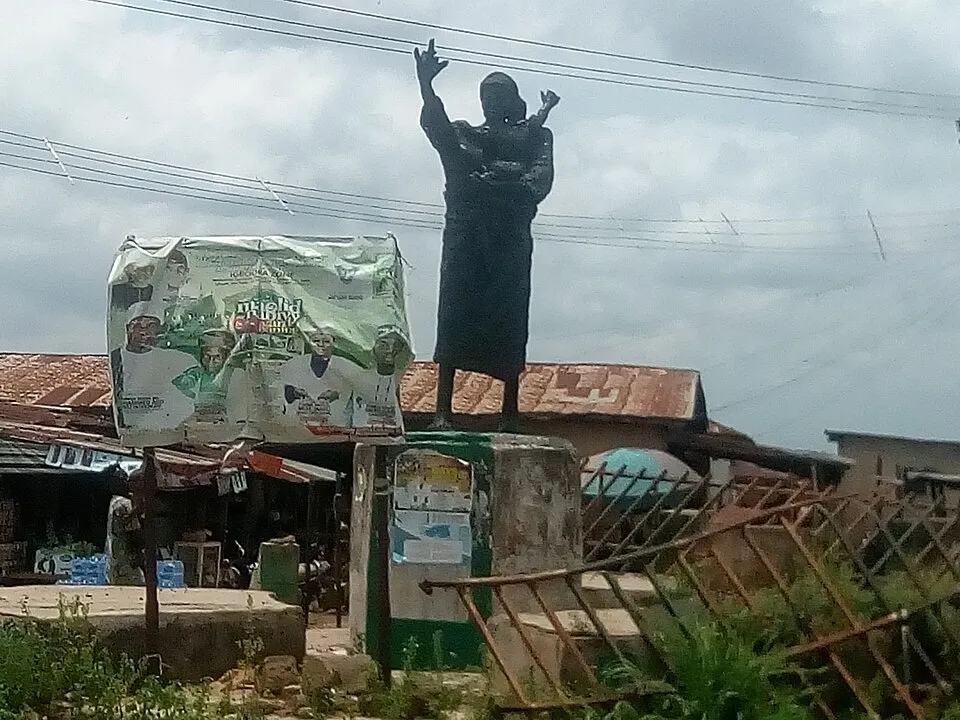
Image: Twins mother statue.jpg — Agbalagba, CC BY-SA 4.0 · source
Igbo-Ora calls itself the twin capital of the world. Is it the yams, the genes, or something else?
If you walk through Igbo-Ora long enough, you start to feel you are seeing double. People who live there like to say that almost every family has at least one set of twins, and it does not take long in the town before you stop thinking they are exaggerating. Igbo-Ora sits in Ibarapa Central in Oyo State, about 80 kilometres north of Lagos, a farming and trading town that most city people would drive past without a second look. Yet it carries a title any town in the world would envy: the twin capital of the world.
Before the twins, though, there is the story of how the town got here, and it is a story of moving house. The people of Igbo-Ora remember a man called Obe Alade as their founder. In the version the town tells, he was of the royal line of the Alaafin of Oyo, and he left Oyo with his kinsmen after losing a fight over a chieftaincy title, because in those days the losing side often packed up and went. When the Olu of Igboora, Oba Jimoh Olajide Titiloye, installed the first Baale of Asako in 2022, he described the new chief as a direct descendant of Obe Alade, the founder of Asako.
Asako was the first stop. According to the oral history, the family settled in a forest called Igbo-Asako, about three kilometres from where the main market stands today, and Obe Alade became the first Baale there. But the place was hard to love. Drinking water was scarce and the mosquitoes were terrible, so terrible that an old saying warns anyone looking for trouble to go to Asako, where the mosquitoes are as big as flies. So they moved to Igbo-Ayin, beside the Ayin river, and built a market on a flat rock they called Apata Itaja. Later they moved again, to a marshy, swampy forest known as Igbo-Ira. People began to call the settlers Omo Igbo-Ira, and over time Igbo-Ira was worn smooth into Igbo-Ora. The old first home is still in their praise name: Omo Igbo-Ora Lasako.
So how many twins are we really talking about? This is where the story gets slippery. The figure most often quoted comes from the work of Patrick Nylander, a British gynaecologist who studied twin births in south-west Nigeria between 1972 and 1982. As the Nigerian Tribune reports it, he found about 16 twin births per 1,000 in Europe, about 33 per 1,000 in the United States, and around 45 to 50 sets per 1,000 live births in the south-west. Duke University's notes on Yoruba twin figures give the same kind of number, about 45 per 1,000 among the Yoruba, the highest anywhere.
Then there are the bigger numbers. People in Igbo-Ora will tell you the town has around 150 or even 158 sets of twins for every 1,000 births. That figure turns up again and again, in newspapers, on a Vietnamese radio show, and in museum notes, but we could not find the study it comes from. CNN put it fairly when it said the exact statistics are debated, but that nobody doubts the town has an unusually high number of twins.
The bigger question is why. Ask in Igbo-Ora and the answer comes fast: it is the food. One man who has spent years promoting the town told the Tribune that it is in the Agida yam, the cassava flour and the okra leaf dishes, and that if you want twins you should come and live there and eat what they eat. Others say it is ilasa, the okra leaf soup, eaten with yam or amala, and that it must be eaten fresh and never stored. There is a little bit of science behind the yam idea. A study at the Lagos University Teaching Hospital suggested that a chemical found in the women of Igbo-Ora and in the peel of yam might play a part. But no direct link between diet and twin births has ever been proven, and many scientists think the answer is simply in the blood, passed down through families. For now, it is yam against genes, and nobody has won.
Whatever the cause, twins in Yoruba life were never just a medical fact. They come with names already waiting for them. The first twin out is Taiwo, short for Taiyewo, which means the one who first tastes the world. The second is Kehinde, the one who comes last. And here is the lovely twist: Kehinde is counted as the elder. The belief is that Kehinde sends Taiwo ahead to check whether the world is good enough to come into, and only an elder sends someone on an errand like that. So the baby who arrives second is the senior one, and everyone grows up knowing it.
Twins are also seen as special, even sacred, able to bring good fortune to their families. That is why the death of a twin was taken so seriously. Families would ask a carver to make a small wooden figure called an ere ibeji to stand in for the child who died. The figure was not left on a shelf. It was washed, dressed, decorated with beads or cowries, and cared for as if it were alive, often until the surviving twin died too. Museums from Belfast to North Carolina now hold these figures, but in Yoruba homes they were family, not art.
In 2018, Igbo-Ora turned all of this into a party. The Oyo State government held the first Twins Festival in the town, and twins came in their thousands. CNN says more than 2,000 twins attended, the Tribune counted 2,034 registered pairs plus hundreds who never signed up, and another report put it at about 2,500 sets. There were parades, a twins talent hunt, food stalls and cultural shows, and families turned out in matching clothes. The plan was to make Igbo-Ora a destination for twin tourism. Ojelabi Sunday Olusola, a cleric and father of twins who says he first pushed for the festival, told the Tribune the idea came to him after a BBC team visited in 2008. For a town that once kept moving to escape mosquitoes, it was a fine thing to have the world come to its door.