People · 1820s–1874 · Disputed
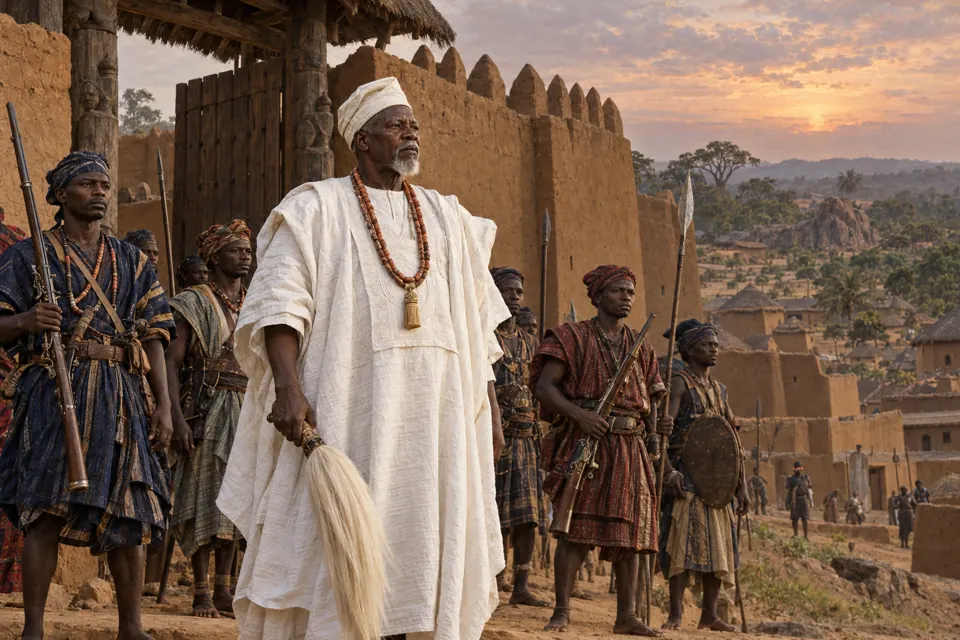
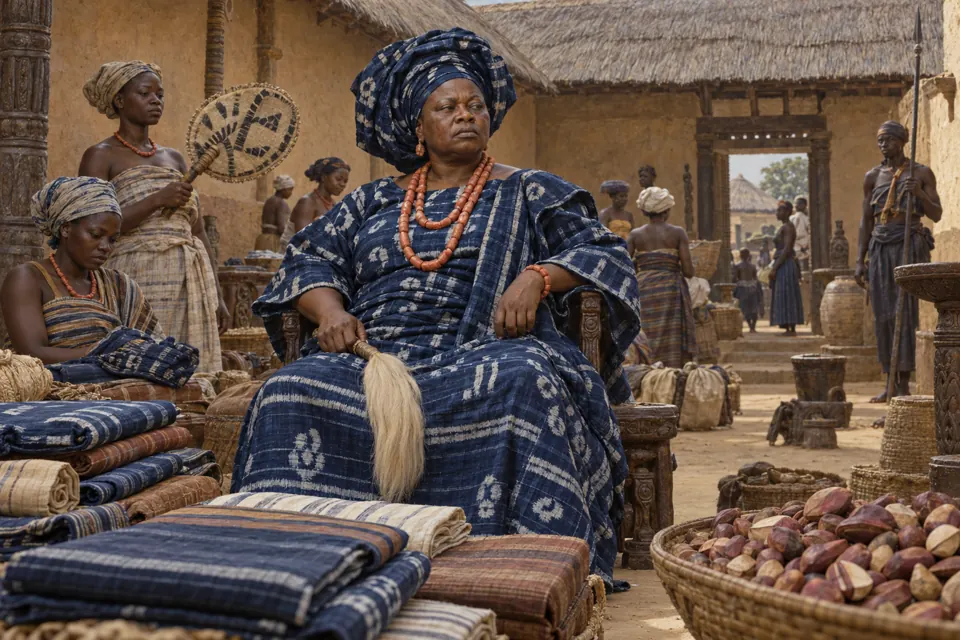
Image: Generated illustration — AI-generated with Codex image tool for Naija Tales, Generated — not a historical image
She owned thousands of workers, lent guns to generals and feared no man. Then the town turned against her.
Her full name tells you how people saw her. Aniwura means one who has gold. Efunsetan was Egba by birth, the daughter of a man called Ogunrin. When she was born is not settled. Some put it in the 1820s, others as far back as the 1790s. What everyone agrees on is that she married and moved to Ibadan, and that Ibadan made her. In those days Ibadan was a war town. Its chiefs were soldiers first, always off on another campaign, and soldiers need guns, powder and food. Efunsetan saw that and built a business on it. She traded with the Europeans down at the coast, carrying goods from the inland towns down to them and bringing imported goods back up, above all guns and gunpowder. Then she did something clever. Instead of only selling to the war chiefs, she lent them arms on credit when they marched out. That meant some of the most powerful men in Ibadan owed her. She also farmed on a huge scale. Oral accounts say she had large farms where a hundred slaves worked at a time, with many more serving in her house, and by the usual count she owned around two thousand people over her life. That was how wealth was measured in Yoruba towns then, and hers was frightening. Some time in the 1860s she was made Iyalode of Ibadan, the chief who speaks for the women of the town. She was only the second woman to hold the title there, after Subuola. As the leader of the women and the woman who armed the soldiers, she sat close to the decisions about war and peace. She even became a patron of the Anglican church in Ibadan. Her old praise poem still captures her: she has horses and does not bother to ride them, she has bullets and gunpowder, she has gunpowder as well as guns, and her wealth is greater than the Aare's.
For all that gold, she had no heir. The tellings agree on the loss but not on its shape. One version says her only child died at birth. Another says it was a grown daughter, who died while giving birth herself, around 1860. One modern writer goes further and doubts there was ever a child at all, and asks whether the grief story was added later to explain a powerful woman. Whatever the truth, the woman who comes out of the stories after that loss is hard to look at. She is said to have beaten her slaves again and again, and to have starved the ones who displeased her. Then came the rule that made her name a byword. No slave woman in her house was allowed to become pregnant, and no slave man was allowed to court one. The punishment for breaking it was death. How many died for it, nobody truly knows. The numbers come from Akinwumi Isola's famous play and from oral memory, and they do not even agree with each other. One account says forty-one, another says about twenty women and thirty men. It is worth remembering that these were human beings who simply fell in love or got pregnant, and it is also worth remembering that the story was told, and retold, by people who had their own reasons to paint her as a monster. Both of those things can be true at once. Was she cruel? Almost certainly. Was every cruel story about her true? We cannot say.
Her fall came from the same place as her rise, the war business. By the 1870s the ruler of Ibadan was the Aare Latoosa, a great general who borrowed arms from her like everyone else. He and his chiefs were slow to pay what they owed, so she stopped giving them credit. When Latoosa marched out on another campaign in 1874, she held back her usual help. When he came home, he charged her with three things: she did not send her fighters with him, she did not send supplies, and she did not come out to the town wall to greet him on his return. On 1 May 1874 he took the title of Iyalode from her. She paid every fine they put on her and sent costly gifts to other chiefs, begging them to plead for her. It made no difference. The chiefs ordered her to leave Ibadan, and she refused. Her rank meant she could not simply be executed in public, so the plot went inside her own house. Latoosa's side bribed her adopted son, Kumuyilo. On the night of 30 June 1874, two of her slaves, sent by him, killed her in her sleep. Another telling says she drank poison when they came for her. Her own people in Egbaland would not let it rest. They demanded to know how she died, and Kumuyilo, under questioning, named three of Latoosa's close aides. He lost his place as head of her family, and the two killers were put to death. Historians still argue over why Latoosa wanted her gone. Some see a jealous man who could not stand a woman that powerful. Others say Ibadan had simply come to lean on her guns and her credit too heavily. Isola's play made her famous, and films followed, the latest starring Clarion Chukwurah in cinemas from 31 January 2020. Today her statue stands in the middle of Challenge roundabout in Ibadan, and the traffic goes round her every single day.