Legend · Ancient to 1923
No matching image yet, so this page uses a plain title card instead of a photo.
The people of Idanre say their ancestors fled Ife with a stolen crown, climbed a wall of granite and cried out in wonder. They stayed up there for centuries, and only came down to the plain in 1923.
Drive into Idanre in Ondo State and the first thing you notice is that the town looks small. Behind it, and almost on top of it, stand huge bare hills of grey rock, about 3,000 feet high. A writer for The Sun newspaper once told of an Idanre man who had lived all his 43 years in Lagos. When he finally came home with his wife and children and arrived at dusk, the hills frightened him so much that he would not sleep in the town. He drove back to Akure for the night. It sounds like a joke until you stand there and look up.
The rock itself is very old. Geologists say it is a granite mass about 500 million years old, split by big cracks that have become deep valleys. But the people of Idanre tell their own story of how they came to live on it.
According to their tradition, a descendant of Oduduwa, the father of the Yoruba, left Ile-Ife long ago with a band of followers. They did not leave empty-handed. They took a magic crown, the Ade Omo Oduduwa, the crown of Oduduwa's son. The people of Ife were angry and chased them deep into the forest, and the group wandered for many years with no settled home. At last they came to this range of hills and were struck dumb. The cry that came out of them was "Idanre!", which the story explains as "this is a wonder". The name stuck.
They climbed up and made their home on the top. The tradition says they stayed up there for over 800 years. Only in 1923 did the people begin to move down to the land at the foot of the hills, where the modern town now spreads out. Even today, festivals bring the lowlanders back up the hill to act out old stories and meet the place their ancestors called home. In 2007 the hill was placed on UNESCO's tentative list for World Heritage status.
Getting up is the first test. Idanre people count nine wonders on the hill, and the first is Ibi Akaso, the steps. There are 660 of them, winding up the rock with five resting points along the way, each some distance apart. People who have climbed them say you need strong legs and a calm head for heights.
Many of the other wonders are tied to one figure, Agboogun, a hunter whom the stories give supernatural power. One tale says he set out on a journey with three companions. On the way he stopped and carved marks on a hillside that nobody has ever been able to read. They are called the Unreadable Signs. A little further on, he scored another rock with broad criss-cross lines, and that became the Wonderful Mat. At the foot of a steep hill called Aghagha he struck his foot against the stone and left a print in it. This is Agboogun's Footprint, and it has a job to do. People accused of witchcraft are asked to put their foot in it. The belief is that it fits any foot at all, except the foot of a wicked person.
Agboogun also guards the crown. The story goes that a thief from Ile-Ife once managed to steal the magic crown back, and the hunter chased him. He struck the ground with a magic staff and the thief froze on the spot. Agboogun cut off his head and took the crown home. On that same ground, tradition says, the king of Idanre still puts on the crown once a year.
There is water with a warning in it too. Omi Aopara, the thunder water, is a spring on the hill. Before going to war, the story says, warriors would line up to drink from it. If thunder rumbled while a man was drinking, it meant he would die in battle, so he was left at home.
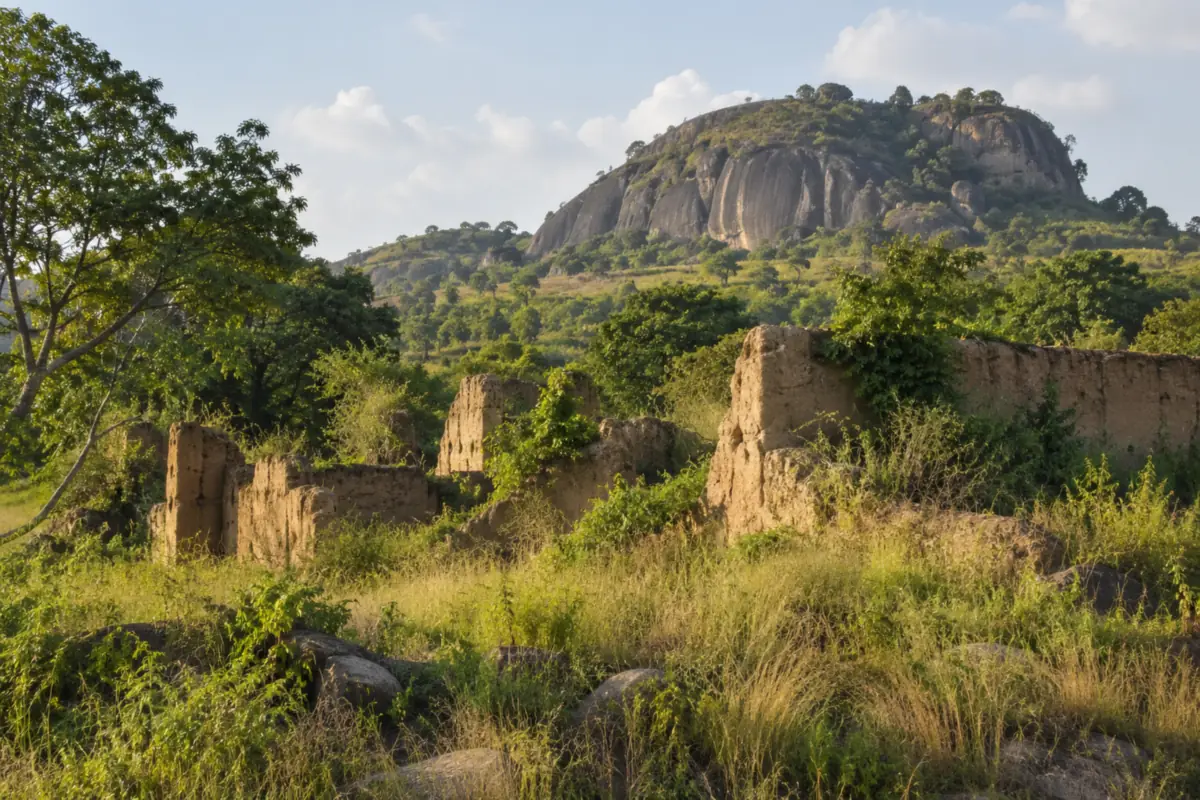
Up on top, the old settlement is still there, almost like a town that was simply switched off. There are old houses, the ancient palace, a court, a prison, and the remains of a primary school. The palace is a low mud building with an inner courtyard held up by carved pillars. Inside are animal skulls from the yearly sacrifice of a cow, and their number marks how many years the king has reigned.
Near it stands a run-down house with a black slate sign telling visitors to take off their shirts before entering. It belonged to a chief who, it is said, wore nothing but a single wrap of cloth. Behind it is a small walled house that served as the prison, and close by is the court. The written record matches this in part. Missionaries led by a Reverend Gilbert Carter reached the hilltop town in 1894, built its first primary school out of clay in 1896, and a law court with a prison was set up in 1906.
Above the old town a huge boulder sits on a ridge over a hut, looking as if it might roll at any time. People call it the Wonderful Rock. Far off is Orosun Hill, which seems to wear a haze of smoke all day. The local story says Orosun was a woman warrior who protected Idanre and then vanished at the foot of the hills, where a shrine now stands. The Arun River flows from under her hill and is said to heal.
The hill is a home for living things as well as memories. A small toad called Perret's toad is known from this one place in the world. Rock hyraxes live among the boulders, though hunting is thinning them out, and the Idanre forests are one of six places in southern Nigeria where forest elephants are still found.
And then there is Ogun, Idanre's most honoured god. Wole Soyinka visited in 1962, and in 1967 published a long poem called Idanre that makes the hill Ogun's home. Each October the town dances for him. The high chiefs dance with their groups, and the king dances last on the way up to the hill. The belief is that any chief the king catches up with will have a terrible year, and may not live to see the next one. So the chiefs dance, and they keep moving.