People · 1945-1956 · Disputed
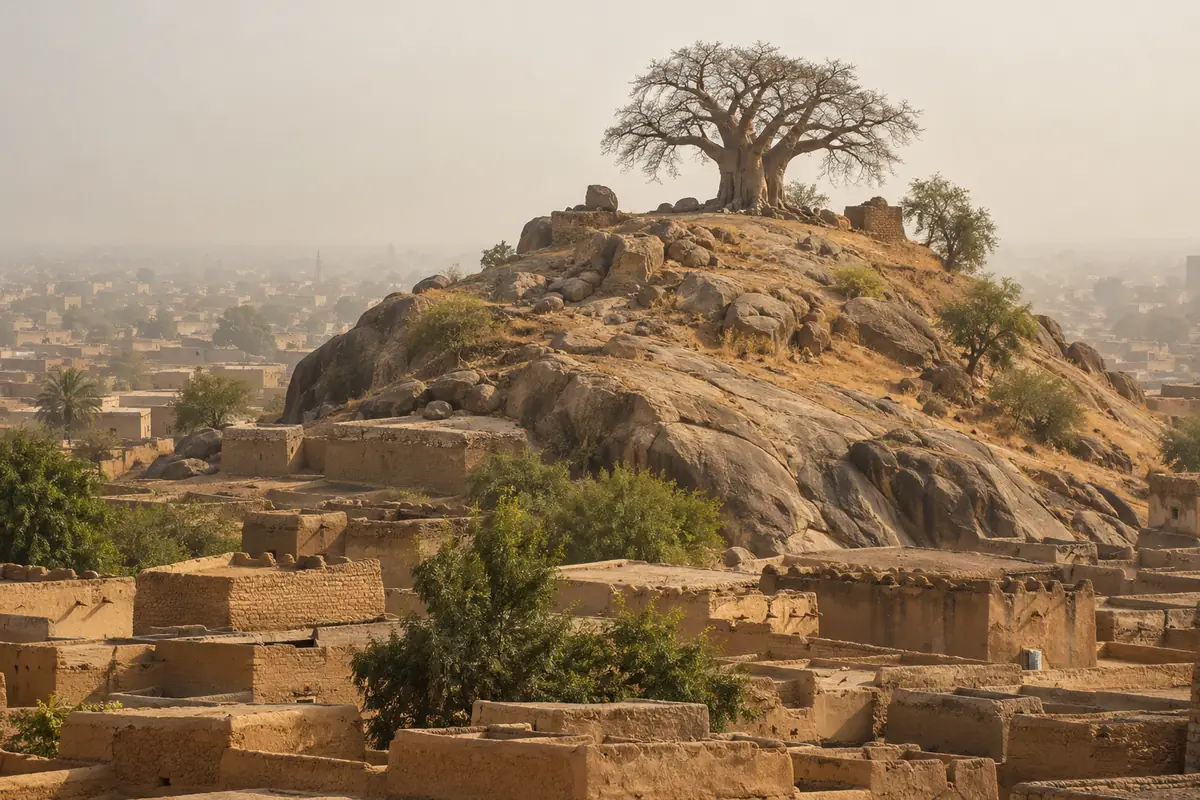
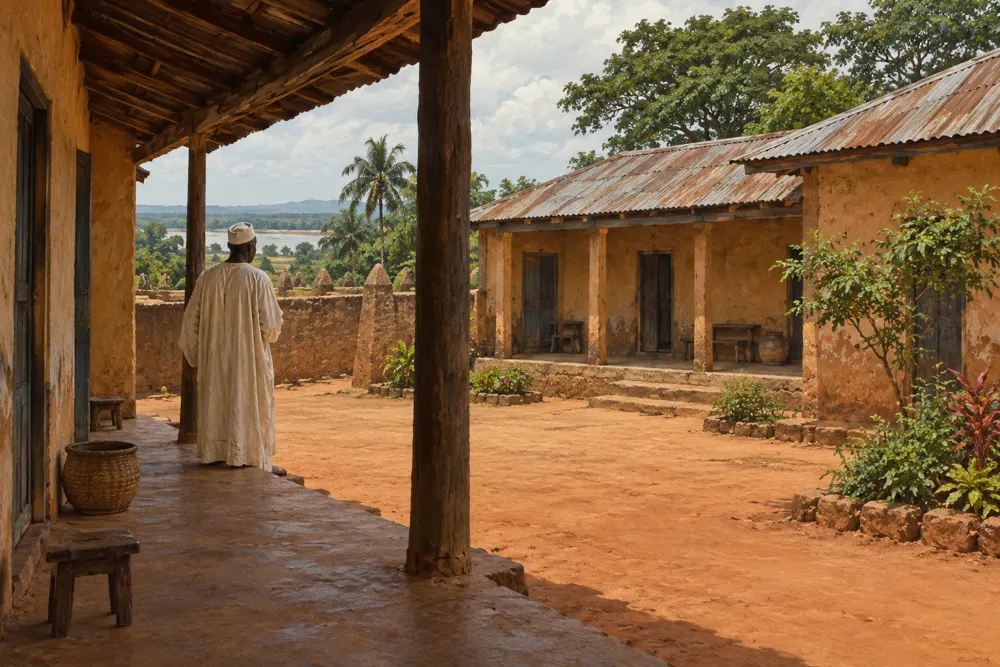
Image: Generated illustration — Generated with an AI image tool for this site, Generated illustration, not a historical image
In 1955 a police detective stood at the Ocho festival in Idah, writing down every cock and goat the Attah killed. A year later the king was dead at Dekina.
Nobody expected Ameh Oboni to be king. The Igala throne at Idah rotates between royal lines, and he was a second son. His elder brother Acho was still a young man when the old Attah began his reign, so the crown seemed to belong to Acho's future, not his. The anthropologist John Boston, who lived at Idah in the early 1960s, wrote down the praise name Ameh took when he finally came to the throne. It means, roughly, the war they expected in front broke out behind them. In other words, the unexpected one won. The popular account of his life, retold by WithinNigeria, fills in the rest. He was born around 1911, and his father, also an Attah, died when he was a baby. He grew up with his mother's people near Itobe, then with his brother. As a young man he went off to Lokoja and Okene, found a job with the British waterworks, went to school for a couple of years and learnt to speak Hausa well. When Acho died in 1938, the district officer sent for him, and he became the heir. That account says he was installed on 1 May 1945, just as the Second World War ended. It remembers a busy, ambitious king. He pushed for roads, more Native Authority schools and a dispensary in every district headquarters. When Idah got its first aerodrome, the story goes, the Attah turned up with a machete and hoe, pulled off his flowing gown and worked with the labourers until late afternoon. But Boston recorded something else growing at the same time. Ameh quarrelled with most of his own traditional councillors, he wrote, and with the educated, progressive men of Igala too. That would matter.
Every year the Attah led the Ocho, the great festival of the land, held when the dry grass was ready to burn. In the 1950s a rumour started that the king was killing people at it. So the police sent a detective. His report survived in the files, and Boston quoted it. It reads like a policeman's notebook, which is exactly what it was. On 16 April 1955, at about four in the morning, the Attah led a procession of around 250 people to a spot between his compound and the government quarters, where a red blanket tent stood ready. A Corporal Shado had checked the tent beforehand and found a bed, a red bag, a brass horn with bells and an iron ball. People drifted in, ate and drank. Drummers and dancers played. At about one in the afternoon, the king, in his full robes, sat on a chair inside a ring of burning grass and incense. He blessed the ashes, and people rubbed them on their faces and bodies. Then a priest cut the throat of a black goat tied to a frame of sticks and covered it with a white cloth. On the way home a tortoise was offered, then a white cock at the palace gate. By five it was over. That was all the detective saw. Earlier, at a smaller rite with the king's wives, he had counted one white cock, some dried fish, meat and kola. Boston calls the human sacrifice charge unfounded. WithinNigeria tells it another way: blood from the Ocho ground was sent to Ibadan for testing and came back as animal blood, but too late. Either way, the rumour had done its work. After complaints about how cruelly the goat was killed, and with the sacrifice story going round, the Igala Native Authority council asked for the festivals to be stopped. In 1956 the Ocho and Egwu at Idah were banned by law.
That same year the government withdrew its recognition of Ameh Oboni as Attah. Historical Nigeria notes that early 1956 was also when Queen Elizabeth II toured Nigeria, with a grand durbar at Kaduna. Somewhere in the retelling the two things got fused together. The best known version says the Attah was ordered to take off his cap before the Queen. An Attah must never bare his head in public. When he finally did, bees poured out of it and chased everyone from the hall. Then the handcuffs slipped off his wrists, and he left a locked room to appear in his car on the road to Idah. There is no record of any clash with the Queen. Another version, which went round social media in 2020, put the bees at a Kaduna meeting in 1963 and had him cursing the Emir of Kano. The Kogi lawyer S. O. Akobe pointed out the obvious problem: by 1963 Ameh Oboni had been dead for seven years. Akobe had also seen coconut trees fruiting happily in Dekina, the town the Attah was said to have cursed so they never would. The plainer history is harder. Stripped of his office, the Attah stopped at Dekina instead of going home, and there he took his own life. Boston dates it to June 1956. The popular account says 26 June, and Kogi Reports says 26 August. On 20 October 1956 Aliyu Obaje was installed in his place. People still disagree about why he did it. Popular memory tells it as a king who would not live dethroned. The legend grew out of that. It remembers a man nobody could make bow, because the truth was that he was beaten by petitions, a council and a colonial office. Decades later his son came to the throne as Ameh Oboni II, and WithinNigeria says the banned festivals finally returned after about sixty years, when Governor Yahaya Bello lifted the ban.