Legend · before c. 999 CE (tradition)
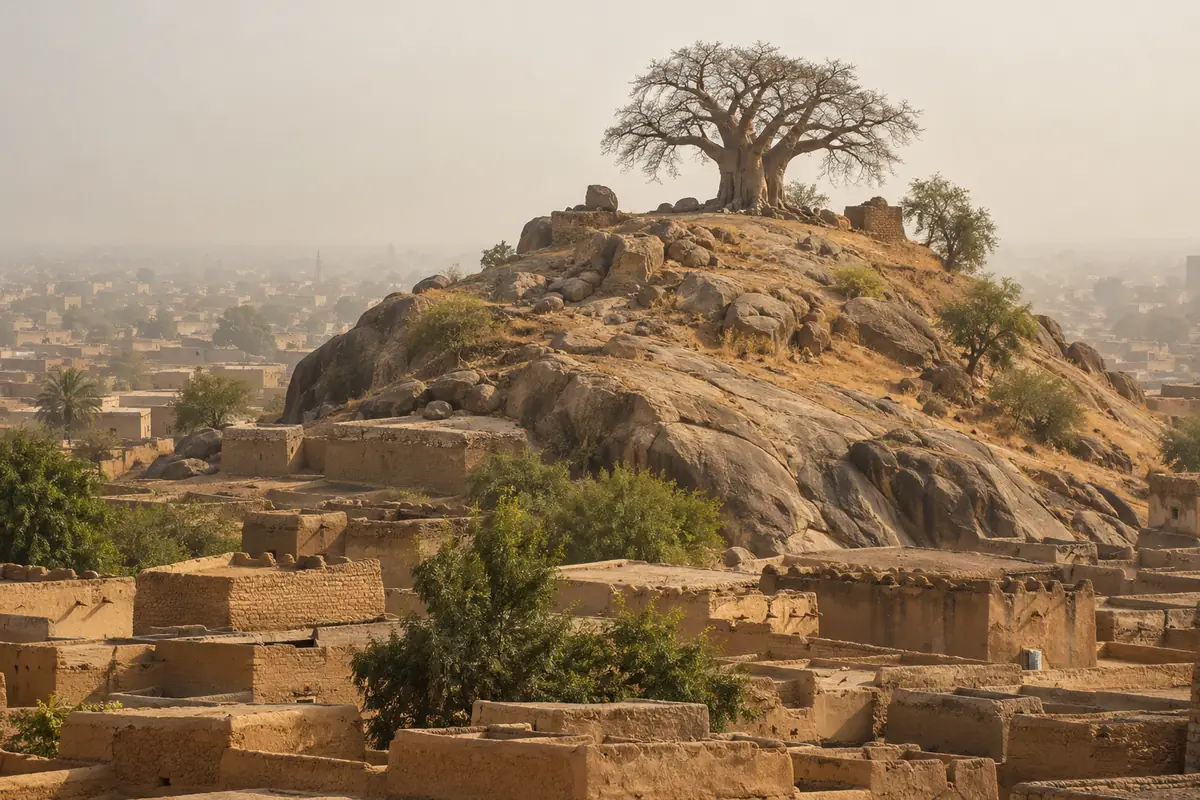
Image: Generated illustration — AI-generated for Naija Tales, reviewed for accuracy, Generated illustration, not a historical photo
Before there was a kingdom of Kano, there was a hill, a baobab tree and a priest who came down only twice a year. His most famous words were a prophecy of his own people's defeat.
Every Kano child knows Dala Hill, the rocky lump that rises out of the old city. Long before the city had walls, emirs or a name we would recognise, the hill was the centre of another world. The people there worshipped their own gods, and the most powerful man among them was a priest called Barbushe.
The tradition gives him a family tree. Long ago, it says, a blacksmith named Kano found iron ore and good farmland in the area. After him came a settler called Dala, who gave his name to the hill and to the first town around it. Dala is said to have shaped the old religion into something more elaborate. One of his four sons was Garageje. Garageje's son was Buzame, and Buzame's son was Barbushe. So Barbushe could say, as he does in one remembered speech, that he was the heir of Dala, and that people would follow him whether they liked it or not.
He was remembered as a giant. The stories say he was enormously tall and strong, and a hunter of such power that he could kill an elephant with a stick and carry it on his back for miles. He learned the rites of the old faith from his forefathers, and soon no other priest could match his knowledge of the god Tsumburbura. Lesser priests came to him for guidance, and he became their leader.
He did not rule alone. The tradition names a long list of chiefs who stood beside him, among them Gunzago, Gagiwa, Doje, Janbere and Jandamisa. Jandamisa led a clan called the Rumawa, who claimed to be descended from the Byzantine Empire, a reminder that even this early Kano liked to tell stories of distant origins.
Tsumburbura was said to live in the Jakara River, which people called the black river because of the colour of its water. His shrine was built around a baobab tree with a name of its own, Shamus.
Shamus was supposed to stand perfectly still. If trouble was coming to the land, the tree would shriek, and smoke would rise from the Jakara. Then the people sacrificed an animal. If the shrieking and the smoke stopped, the danger had passed. If they did not stop, the trouble was on its way and nothing more could be done.
A man called the Mai Tsumburbura guarded the tree. Only Barbushe was allowed inside the sacred place. Anyone else who walked in, the story says, died.
Barbushe lived up on the hill and almost never came down. There were just two days each year when he did, and the tradition says they fell at the same time as the Muslim festival of Eid, a detail that hints at how the story was shaped by those who wrote it down later. As those days drew near, people came from all over the land and gathered at the foot of Dala Hill with their offerings: black he-goats, black chickens and black dogs.
In the dark of the night Barbushe came down with drummers and led the crowd to the shrine. The offerings were sacrificed. The worshippers danced naked around the tree, chanting until dawn, and then they ate. And at the end, Barbushe told them what the coming year would bring.
His most famous prophecy was not good news. A man would come to this land with an army, he told them, and would gain mastery over them. They would see him in the sacred place of Tsumburbura. If he did not come in their lifetime, he would surely come in their children's, and he would conquer the whole country, forget them, and raise up his own people for years to come. He warned that the stranger would burn their sacred tree and build a mosque.
The people asked him how they could stop it. His answer was short. There is no cure, he said, but resignation.
The story says it came true. By the time the newcomers reached Dala Hill, Barbushe himself was dead, and only a few of his followers were still alive. They understood at once that this was the army he had seen. Janbere, one of the old chiefs, remembered his master's words and warned that if these men were let in, they would control the people's future until they lost who they were. Nobody listened. People could not see where these strangers would find the strength to conquer them.
Tradition is not sure whether it was Bagauda himself or his grandson Gijimasu who first met Barbushe's people, but most accounts say Bagauda. Either way, war followed, the leader of the old faith was killed, and the kingdom of Kano was born, traditionally in 999 CE. Bagauda's line ruled for 808 years, until 1807.
What makes the legend so unusual is whose story it is. Kano's founding tale is told from the side of the people who lost. Its hero is not the conqueror but the old priest on the hill, who saw it all coming and told his people there was nothing to do but accept it.