Lost history · November 1999 – 2014 · Disputed
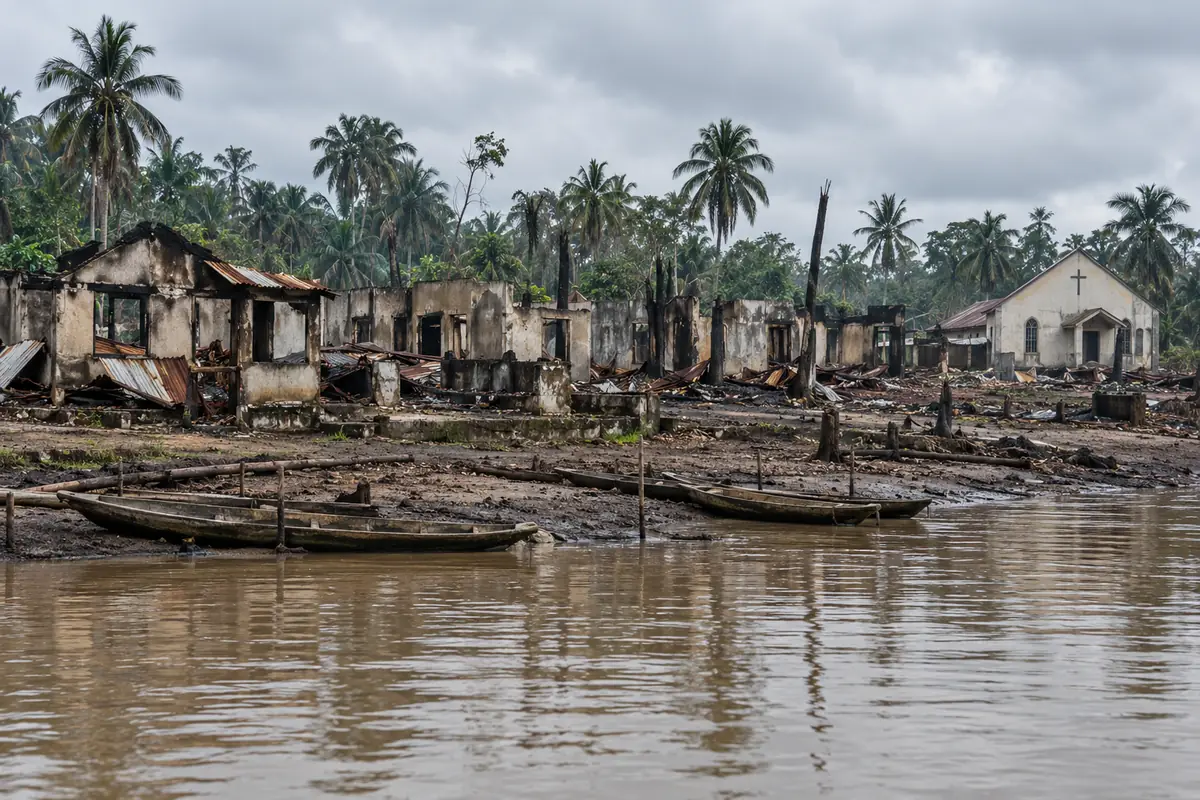
Image: Generated illustration — AI-generated for Naija Tales, reviewed for accuracy, Generated illustration, not a historical photo
Twelve policemen were killed near an Ijaw town. The army's answer left only a bank, a church and a health centre standing.
In 1999 Nigeria had just come back to civilian rule. Olusegun Obasanjo was sworn in as president in May, and many people in the Niger Delta hoped democracy would finally mean a fair deal on oil. A year earlier, young Ijaw people at Kaiama had declared that the land and its resources belonged to their communities. Their anger hadn't cooled off. It had only spread.
Odi is an Ijaw town on the Niger in Kolokuma/Opokuma, Bayelsa State. In November 1999 a gang killed twelve policemen near the town. Seven died on 4 November and the rest over the following days. Who exactly the gang were and how far the town sheltered them is still argued over. What is not argued over is what the state decided to do next. It would not hunt for the killers one by one. It sent the army to Odi.
The military's own version is that troops were ambushed on the road as they approached the town, then broke through and swapped fire with armed men inside who were using civilians as cover. That version matters, because it is the army's explanation for what happened over the next days. But even if every word of it is true, it can't explain what the soldiers left behind them.
The attack came on 20 November 1999. By the time the soldiers were done, Odi had been burned almost to nothing. Every building in the town was burnt down except three: the bank, the Anglican church and the health centre. Homes and shops were all gone. People who returned found the town flattened, and many had nowhere to go back to.
Human Rights Watch pieced together how it unfolded. After the first seven police deaths, President Obasanjo wrote to the Bayelsa governor, Diepreye Alamieyeseigha, and threatened a state of emergency if the killers were not caught within two weeks. The soldiers did not wait for that deadline. They reached Odi, a town of perhaps 15,000 people, around 2 p.m. on that Saturday, while the governor was away at his party's convention in Abuja. Residents fled into the bush with only the clothes they had on. For about two weeks they watched smoke rise over their homes, and when the troops left around 1 December, the walls that still stood carried graffiti saying the Ijaw as a whole had to be punished.
How many people died? This is where the record falls apart. The government first said 43, and that figure included eight soldiers. Human Rights Watch went to look and wrote, carefully, that soldiers "must certainly have killed tens of unarmed civilians" and that "figures of several hundred dead are entirely possible." Nnimmo Bassey of Environmental Rights Action said nearly 2,500 civilians were killed. Others have put it at over 900. Nobody has a final list, and with a town that size burned, maybe nobody ever will.
Most people hold the federal government of the day responsible, meaning Obasanjo and his vice-president, Atiku Abubakar. It was a hard thing for the new democracy to explain. It had come in promising a break with military rule, and within six months it had used soldiers to destroy a town. In the creeks, many took it as proof that the Kaiama youths had been right about how the state saw them.
The story turned up in music and poems too, not just reports. The singer Timaya, who is from Bayelsa, wrote "Dem Mama" on his album True Story about it. The poet Ibiwari Ikiriko wrote "Did Odi do the Deed?", a title that is itself a question about who was really guilty.
For years Odi people pushed their case. In February 2013, Justice Lambi Akanbi of the Federal High Court ruled for them. He condemned the government for what he called a "brazen violation" of the victims' rights to movement, to life, to own property and to live peacefully in their ancestral home. He ordered the Federal Government to pay N37.6 billion in compensation and gave it three weeks.
It did not pay in three weeks. The community's lawyers kept up the pressure. The chairman of Odi's case committee later described how, by 2014, there was a threat to enforce the full judgment if the government did not settle. On 26 May 2014 the Ministry of Justice, the community's lawyers, the committee and the king of Odi sat down together, and the government offered N15 billion as a single payment. Goodluck Jonathan, himself from Bayelsa, was president by then, and his government paid it.
You might expect the story to end there, with money and some kind of justice. It didn't, quite. The payment, less than half of what the court had ordered, brought new quarrels inside the community about who should get what. The chairman of the committee was kidnapped in the fallout, and later released.
Even the money became its own story. According to Professor Kobina Imananagha, who chaired the Odi Destruction Case Prosecution Committee, a court in London warned that it would move to enforce the full N37.6 billion if the government had not negotiated and paid by 21 October 2014. That threat, he said, is what brought the Ministry of Justice, the legal team, the committee and the king of Odi to the table on 26 May 2014, where the government offered N15 billion as the one and only payment. When it was paid, it did not bring peace. It caused fresh quarrels inside the community, and the committee's chairman, Professor Zibokere, was kidnapped before he was later released. Meanwhile, Odi had entered the culture. Timaya's song "Dem Mama" came out of it, and so did poems such as Ibiwari Ikiriko's "Did Odi do the Deed?".
Odi was rebuilt, as towns are. But ask an older person there about November 1999 and they may well start with that strange detail: of the whole town, only the bank, the church and the health centre were still standing.