Lost history · Precolonial to 20th century
Image: Generated illustration — AI-generated for Naija Tales, reviewed for accuracy, Generated illustration, not a historical photo
Villages spent years filling a house with painted clay figures, gods, ancestors and even British officers. Then they left it to melt back into the earth.
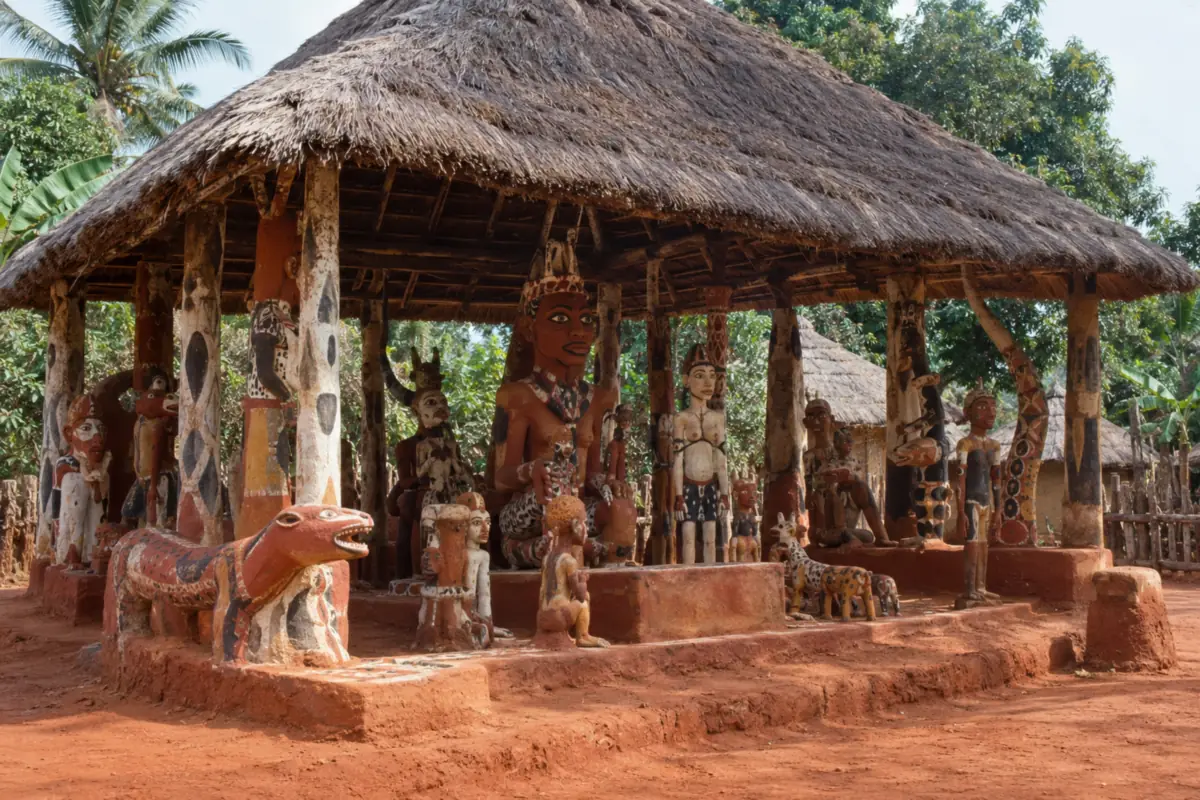
Around Owerri, in what is now Imo State, people used to build a kind of house that no family ever moved into. It was called an mbari. It was square, open on its sides like a pavilion, sometimes rising to two storeys, and it was crowded with sculpture. Life-sized figures modelled from clay and painted in bright colours stood and sat all through it.
The house was not really for people. It was a gift to the gods, and above all to Ala, the earth goddess of the Igbo. Ala was the one who held the land, its fertility, and the moral order of the community. When things went badly wrong, when a disaster came that people believed had a spiritual cause, a community might be told it was time to build an mbari. Sometimes the house was given to Ala alone. Sometimes she shared it with other powers, such as Amadioha, the god of thunder, or the spirits of water.
An mbari was not quick work. It took a great deal of labour and ritual effort, often stretching over many months, sometimes years. The building itself was treated as sacred. The material was clay from anthills, termite earth, which was strong and fine to model. Both men and women took part in the making, the building, the sculpture and the painting.
When it was finished, the town's leaders gathered inside for a ceremony. And then something remarkable happened. Once the ritual was over, entering the house, or even looking at it, became taboo. The community had made a masterpiece and then, in a sense, turned its back on it.
What made an mbari so special was what you found inside it. It was a kind of gallery of everything the community knew and feared and laughed at. Ala sat at the centre in many of them, often shown with children. Around her were the other gods, ancestors, legendary creatures and animals. But there were ordinary people too: craftsmen, officials, men and women going about life.
In the colonial years something new appeared. The makers of mbari did not limit themselves to the old figures. They put in the new arrivals as well. Clay British officers turned up, sitting in state. So did the strange things that came with them, such as bicycles, umbrellas and binoculars. Think of it. A district officer, a man who could arrest your chief, made into a painted clay figure and placed in a shrine alongside the gods.
Scholars do not all agree on what this meant. Some read it as a way of facing a disturbing new kind of power and giving it a place inside an older order of things, so it could be watched and understood. Others see humour in it, a sharp eye turned on the foreigners. Probably both are true at once. What is clear is that the mbari were never frozen, old-fashioned things. They were alive to the world around them, and they recorded that world as it changed.
The Igbo word itself is often explained as meaning creation, and that fits. An mbari was a community's way of making its whole world again in miniature, gods and neighbours and strangers together, and offering it up.
Here is the part that surprises people most. The mbari were made to fall apart. They were not like a church or a mosque, meant to stand for centuries. The clay was left to the rain and the sun. Slowly the figures cracked, the paint faded, and the whole house sank back into the ground. That was the point. The offering went back to Ala, the earth, which was the goddess herself. Some put it this way: the goddess was satisfied once she had taken the gift back into herself.
So the decay was not failure. It was the last stage of the ritual.
Of course, that also means most of the old mbari are gone. British observers began documenting them in the early twentieth century, and photographs taken in the 1930s and later, such as those by the colonial officer and anthropologist G. I. Jones, now held at Cambridge, preserve houses that no longer exist. The art historian Herbert Cole spent years studying them and wrote the standard book on mbari in 1982. The tradition was already thinning, and the Nigerian Civil War of 1967 to 1970 did further damage in the region.
In later years some mbari were made in cement, so they would last, and you can still find examples around Owerri. That keeps the images alive, but it quietly turns the idea upside down. A cement mbari survives. A true one was always meant to disappear. Perhaps that is the most moving thing about them. For generations, people around Owerri put their best art, their deepest fears and their sharpest jokes into houses they knew would melt away, and they believed that was exactly how it should be.