Lost history · Dates uncertain; c. 200 CE onward is one estimate · Mixed
Image: Ikom monoliths.jpg — Dotun55, CC BY-SA 4.0 · source
About three hundred carved stones stand in circles in the villages around Alok, each with its own face. Nobody can fully read them, and some have been smuggled to America.
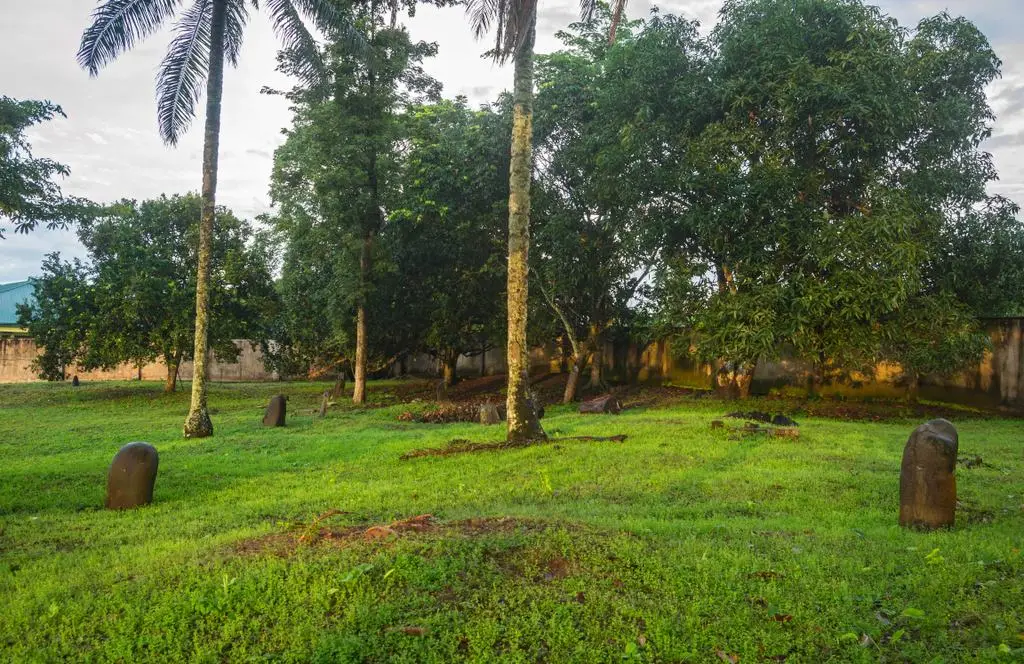
Imagine walking into a village near Alok, in the Ikom area of Cross River State, and finding a ring of stone figures standing in the open, turned inward to face each other, like elders sitting in council. That is what the Ikom monoliths look like. The Ejagham call them akwanshi, or atal. There are around three hundred of them, spread over more than thirty communities and laid out in about thirty circles. Some circles are nearly perfect.
Where they stand differs from place to place. At Alok and Agba they are right in the heart of the village, in the meeting place where the elders gather. At Etinan and Nabrokpa they are outside the village, in a patch of forest nobody farms. So they aren't hidden in a temple or behind a palace wall. They are simply there, and in many places people live their daily lives around them.
Most are carved from hard basalt, a dark volcanic rock, with a few in sandstone or shelly limestone. In shape they are phallic, rounded columns rising from the ground. The smallest is about knee height and the tallest over five feet. Then come the faces. Carvers cut two eyes, a nose and an open mouth into the stone, with rings around the head like a crown, a pointed beard, and often two hands with five fingers each. Many have a large, carefully marked navel, and around all of it run geometric patterns and facial marks.
The UNESCO description makes a lovely point: each stone is as unique as a fingerprint. They share a family style, but no two are carved the same way.
This is where honesty matters, because the stones attract big claims. What we know is what's carved on them. What they mean is still an open question.
Some researchers and linguists think the patterns may be a kind of writing, or at least a system of coded signs. Some have linked them to nsibidi, the old sign system of the Cross River region. Nigeria's submission to UNESCO goes further. It says the stones carry "a form of writing and a complex system of codified information", that the geometry suggests the carvers understood mathematics, and it even calls them West Africa's answer to Stonehenge. Bear in mind that this text comes from a nomination, written to make a case. The signs have not been deciphered.
Their purpose is just as uncertain. Were they ancestors, carved so that the dead could keep standing among the living? Memorials to particular rulers? Markers for ceremonies held in the circle? Scholars disagree, and digging under them has not always turned up burials, which would have settled the question. The faces carry their own puzzle too. The marks on cheeks and foreheads look like scarification and hairstyles that people no longer wear, so the stones may record how people once looked, in a way skin and cloth never could.
Dating is just as uncertain. One estimate puts the carving as early as around 200 CE, and others argue for much more recent centuries. When you hear a single confident date, be a little suspicious.
Much of what outsiders know comes from careful recording. In the colonial period, Philip Allison studied and wrote about the stones, and his work became the starting point for later research. Of course, the communities themselves had always known where every stone stood.
Basalt lasts a long time, but it doesn't last forever. Years of sun and heavy rain have worn some faces smooth. Others have fallen or been damaged by people. In 2008 the World Monuments Fund added the Ikom monoliths to its list of heritage sites in danger. The official write-ups admit another problem: many people living nearby do not see the stones as a tourist attraction, so there is little local money or pressure to protect them.
Then there is theft. Pieces of akwanshi have ended up in collections abroad. The British Museum has a medium-sized one with a human face. And in 2020 US Customs and Border Protection officers at Miami International Airport found Ikom monoliths travelling on fraudulent paperwork. At first, officials said the pieces would go back to Cameroon, a mistake that shows how little the outside world knew about where they came from. They were then marked for return to Cross River State in Nigeria. Commentators pointed out that the smuggling showed how few heritage and archaeology staff Nigeria has to guard sites like these.
The monoliths sit on Nigeria's tentative list for World Heritage status, which is a sort of waiting room. Making the full list would bring attention and maybe money. For now, the stones remain where they have always been, in the meeting places and the uncut forest, facing each other in their circles and keeping whatever they mean to themselves.