Legend · Late 15th century to today · Mixed
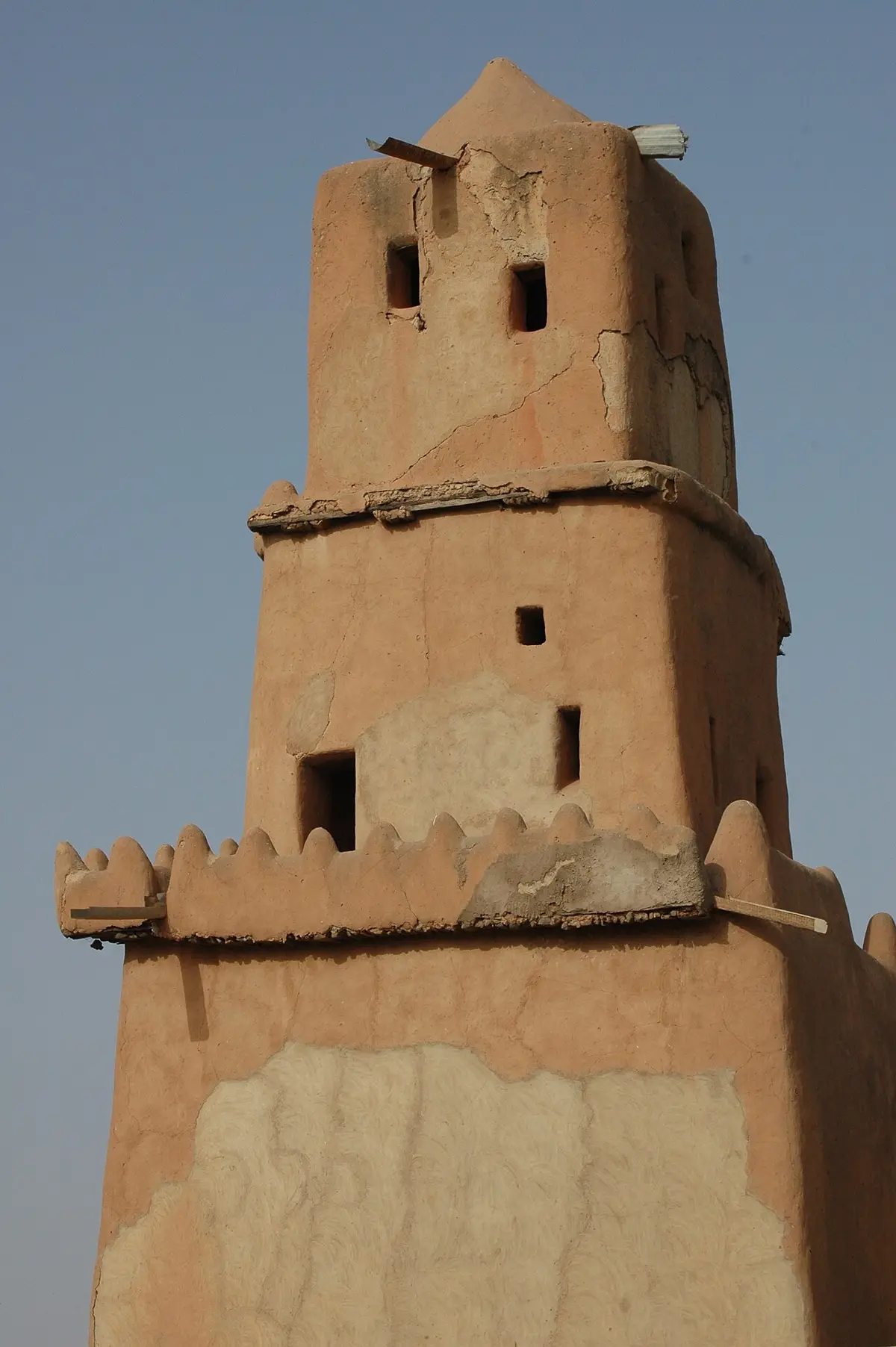
Image: Gobarau Minaret Katsina.JPG — Derric Evans, Public domain · source
Scholars from Timbuktu once taught astronomy and law beside this mud tower in Katsina. Centuries later, an old master builder refused to copy it in Jos, because he was told the original would be pulled down.
In the Gobarau quarter of Katsina, along the old Market Road, a mud tower rises above the houses. It is the Gobarau minaret, and its image is part of the official insignia of Katsina State. Most people see a tower. It is actually the last surviving part of something much bigger: a mosque that once worked as a university.
The story goes back to the late fifteenth century. The scholar Muhammad Abdulkarim al-Maghili, who came from Tlemcen in North Africa, visited Katsina during the reign of Muhammadu Korau, remembered as Katsina's first Muslim ruler. The two men are credited with the idea of building a mosque that would be a centre for both prayer and study. Gobarau became the first Juma'at mosque in Katsina, the place for Friday prayers.
It soon drew scholars and students from across the western and central Sudan and the Maghreb. Some historians believe it was connected to the famous Sankore in Timbuktu. The historian John Hunwick wrote that many Timbuktu scholars who went on pilgrimage to Mecca stopped in Katsina on their way home and stayed for a while to teach.
The subjects taught there would surprise people who imagine the old north had only Qur'anic schools. According to the Sunday Trust report, the curriculum included Qur'anic recitation, Hadith, Islamic law and jurisprudence, but also mathematics, astronomy, astrology, logic, Arabic grammar, poetry, history and philosophy. Among the early teachers named are al-Maghili himself, Qadi Muhammad al-Tazakhti, Umar bin Aqit and Ahmed Baba of Timbuktu.
The exact date is argued over. The paper called it 664 years old in 2012, while other sources date the building anywhere from the fifteenth to the eighteenth century. What nobody disputes is that it was once the tallest building in Katsina.
The minaret is made of local materials: mud, clay and the cone-shaped bricks called tubali, with date-palm timber used for the roof, doors and windows. A coating called katsi protects it from erosion. Today it stands about 17 metres high on three floors, each smaller than the one below, with a staircase leading to the top.
There are holes in the walls facing all four directions. After the mosque declined, those holes became lookouts. During the wars of the nineteenth century, people watched from the tower for enemies approaching Katsina.
Why did the mosque decline? There is no written record. Dr Sani Lugard, the Wazirin Katsina, suggested in his 2004 book that enthusiasm for Islamic learning faded in Hausaland in the seventeenth and eighteenth centuries, which matches Hunwick's view of the period as a setback. Other reasons are given too: mosques spread to every part of the city, Qur'anic schools moved into the entrance halls of private homes, and in 1807 the first Fulani emir of Katsina, Ummaru Dallaje, built a new central mosque.
The tower itself suffered because builders could not reach the top to repair it. According to the report, Emir Muhammadu Dikko ordered its height reduced so it could be maintained. Then, in 1927, a teacher at the Katsina Training College, E. Mart, photographed the ruins and showed them to colonial officials. People in Katsina became worried, and Emir Dikko called master builders to his palace and ordered them to rebuild it. The minaret you see today is their work.
There is one old belief connected to it. The heritage officer Musa Muhammad Kangiwa said people once thought anyone who climbed to the top could see the Ka'aba in Mecca. He said it was not true, just a sign of how tall and holy the building seemed.
The most human part of the story belongs to Alhaji Ma'aruf Audu Gafai, the Sarkin Magina, head of Katsina's traditional builders. In 2012 he was 82 and had looked after the minaret for 50 years. Only he could permit builders to work on it, and he led every repair. At the time he had 14 builders and 40 labourers on the job.
He told Sunday Trust a story. Under Emir Usman Nagoggo, colonial officers took him to Jos to build a copy of the minaret and parts of the emir's palace. He led 13 builders there and stayed three years. The local clay and sand in Jos were no good, so five tipper trucks brought Katsina soil every Friday. They built three rooms. But they never built the tower, because, he said, someone quietly told him that once a copy stood in Jos, the original in Katsina would be destroyed.
It is his account, and we cannot check it. But it fits a man who spent his life keeping one tower alive.
The federal government declared Gobarau a national monument in 1959. The Katsina Emirate Council repaired it in 2004, the American Embassy funded work in 2009, and the state was renovating it again in 2012. Visitors come from Germany, Morocco, Argentina, Ghana and beyond. They come to see a mud tower. What they are really looking at is a school.