Legend · Traditional founding to 2024 · Disputed
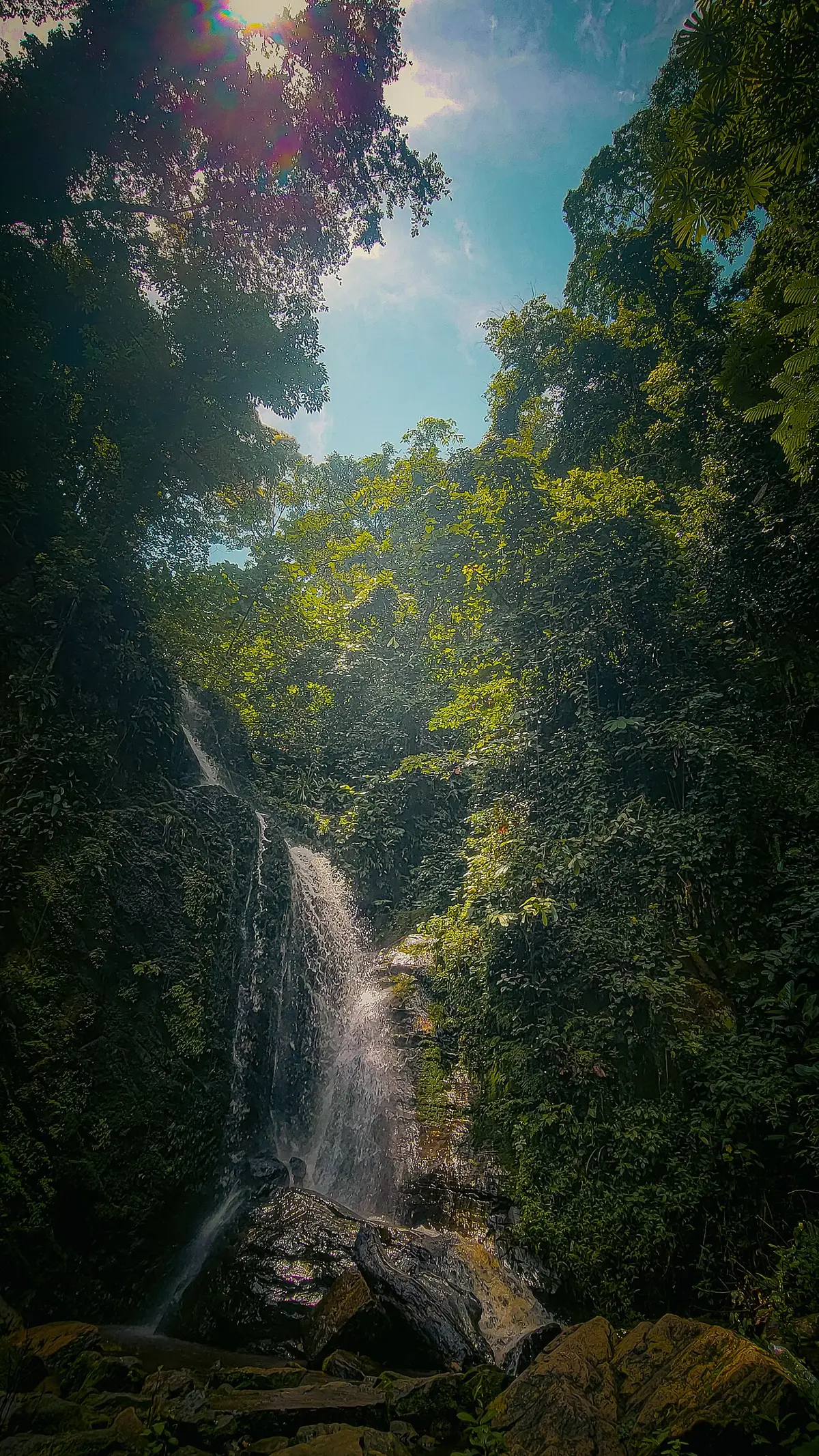
Image: Cascading Serenity, A Tier of Olumirin Waterfall Amidst Lush Canopy.jpg — Timiadekola, CC BY-SA 4.0 · source
The people who found Erin-Ijesa's waterfall called it "another god". Nobody agrees on who found it, a family farms on top of it, and in 2022 the town's young people simply took it over.
Erin-Ijesa sits about 31 kilometres southeast of Ilesa, just off the Ilesa-Akure road, hemmed in by Efon-Alaye to the north and Ipetu-Ijesa to the south. Everyone knows the town for one thing: a waterfall that comes down out of the hills in seven steps, white and loud and cold. Its proper name is Olumirin, and the story of that name is older than the town.
The way the present king, the Akinla of Erin-Ijesa, tells it, the founders came from Ile-Ife. They were a small party, a leader, her husband, some aides and some hunters, walking and searching for a place to settle. After a long search they came on water pouring out of the hills and never stopping. It frightened them as much as it amazed them. They called it Olumirin, which the king explains as "Oluwa miran", another god. To them this was a power in its own right, separate from Iro, the deity the town already worshipped. In time they prayed to the falls for protection, for rain, for a clean mind and for freedom from disease.
Here is the interesting bit. The king, speaking to reporters in 2016 and again in 2024, describes the founder Akinla as a woman, the only daughter of Oduduwa, and puts the departure from Ife at 1140 AD. But in 2016 a young tour guide at the gate told the same newspaper a different story. In his version Akinla was a man, a hunter, Oduduwa's brother, sent by the dying Oduduwa to go and live near the falls with his family, and he found the water on one of his hunting trips. Same name, same falls, same Ife origin, and two founders who are not even the same sex.
Neither version can be proved. Both are what people in Erin-Ijesa say. What is clear is that the falls and the town were bound together from the start, so tightly that the ruler still carries the founder's name as his title.
Most visitors stop at the bottom. Stairs cut into the rock take you up the first two levels, where people stand under the spray and get soaked. After that the stairs end. Anyone who wants to go higher has to climb, grabbing tree roots and wedging feet against pebbles, for about two hours.
At the top, on the seventh level, there is a village. It is called Aba-Oke, or Ajebamidele Aba-Oke in full. When a Tribune reporter made the climb in 2016, he found mud houses scattered over a rocky green plateau, a fog sitting on everything at one in the afternoon, and families who had been living there for decades. There was no electricity. There was no road. The residents went up and down the same way the reporter had, through the rocks beside the water, sometimes carrying loads of produce on their heads. Children did it too, to get to school in the towns below, and some grew up there and went on to graduate from university.
The soil up there is very good. They grow cocoa, kola nut, cassava, yam and corn, and turn the cassava into garri. One woman said they carried their goods as far as Ibadan and even Sokoto. A great-grandmother called Mama Faderera, originally from Oyo State, said she had kept market stalls in Oshodi, Agege and Oyingbo in Lagos in her younger days, all supplied from the top of a waterfall.
There is a twist in the map, too. A resident told the reporter that up on the plateau you are actually in Ekiti State, on Efon-Alaye land, while the bottom of the falls is Erin-Ijesa in Osun. The settlers' own story is that the first man up was a hunter from Efon, sometimes called Baba Ode, who found the path during a land fight between Erin and Efon and stayed to guard it. Elizabeth Oladele, a daughter of one of the first settlers, remembered her father offering pigeon, locust bean, groundnut and sugarcane to the stream, and pounded yam with egusi, like a small festival, to ask for good weather. When he died, the offerings stopped.
The villagers say they hardly ever fall ill, and that when they do, they wash in the stream and get better. "The stream is our health centre," one woman said. A geologist from Obafemi Awolowo University offered a plainer view: the rock is quartzite, the same ridge that runs to Ikogosi, and the water is pure and full of minerals that make the soil fertile.
For all its fame, Olumirin has been poorly looked after for a long time. In 1984 the town's king at the time, Oba Stephen Adeosun, wrote to the old Oyo State government asking for an access road and basic facilities. Nothing much came of it. When Osun State was created, the town kept writing. By the 2020s the final stretch of road was close to impassable, and there was no security at the gate.
What the state did do, residents said, was collect gate fees, about N500 for a child and N1,000 for an adult. A local musician who used to play for visitors on festive days put it bluntly: the government took money from tourists almost every day and put nothing back. So in December 2022 the young people of Erin-Ijesa took over the management of the falls themselves. The king confirmed it. He said the money was now going into the town, including a fence for his run-down palace.
Then, in late 2024, a visitor filmed a short video at the base of the falls. People were swimming happily while two heaps of plastic bottles and paper sat on the rocks beside them. His voice shook as he spoke about people disrespecting their own heritage. The clip spread fast. Within weeks the governor had visited, the information commissioner said the community now officially managed the site, and a meeting between the ministries and the town's leaders was ordered.
A professor of cultural studies at Ife said the fix starts with the obvious: clean it, secure it, and build somewhere for visitors to sleep. Whether that happens is still an open question. But it is quite a journey for one waterfall. It started as a goddess that frightened a band of migrants from Ife, became the home of a village in the clouds, and ended up as the place where a town's young people decided they had waited long enough.