People · 1921
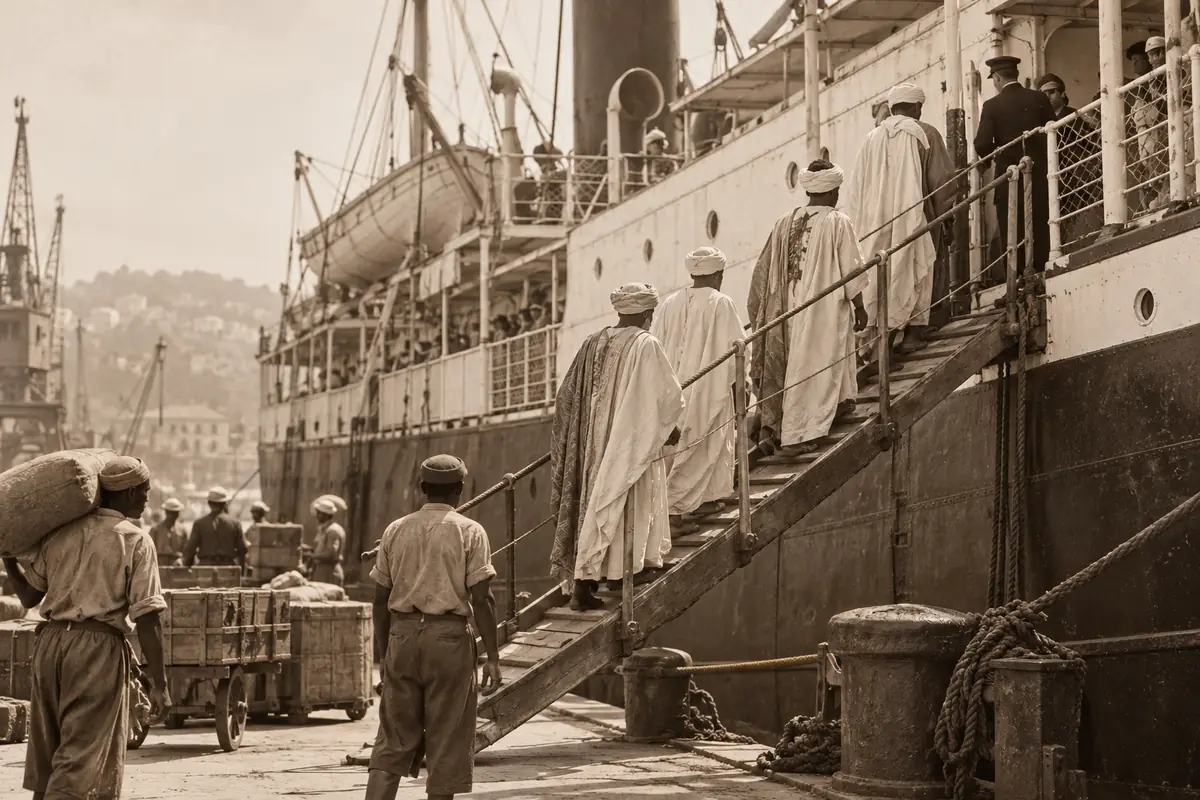
Image: Generated illustration — AI-generated for Naija Tales, reviewed for accuracy, Generated illustration, not a historical photo
In 1921 the Emir of Katsina went on Hajj, and took a long detour through England on the way. A thirteen-line letter in a London archive shows what struck him most.
Muhammadu Dikko was born in 1865 into a family that made kings rather than one that was born to be them. His father, Muhammadu Giɗaɗo, held the title of durɓi in Katsina, which means kingmaker. Dikko inherited that title, and with it a seat close to the throne. He became a trusted adviser to the emir of the day.
Those were unsettled years in Katsina. The British were taking control of the North, and Dikko made a point of getting on well with them. That relationship mattered. When the throne fell vacant, the colonial power favoured him, and in 1906 the kingmaker's son became the 47th Emir of Katsina, one of the seven old Hausa kingdoms. He would reign for 38 years, until his death in 1944.
Dikko was not a ruler who kept the new world at arm's length. He backed government schooling more steadily than almost any other emir, and he was curious about the places the British came from. In 1921 he got the chance to see one of them for himself.
That year he set out on the pilgrimage to Mecca. The usual idea of a Hajj is a straight line from home to the holy city and back. Dikko's was not straight at all. On either side of the pilgrimage he passed through London, once in the summer of 1921 and again in the autumn. Scholars describe him as the first sitting emir from northern Nigeria to visit England, and the colonial government arranged for him to meet King George V.
He did not travel alone or forget what he saw. His personal secretary went with him and helped him keep a diary of the whole journey. That diary still exists, in the National Archives in Kaduna. Historians who study the trip today read it as a window into how the British and the northern rulers used each other: the Empire showing off, and the emir quietly taking notes.
On 12 July 1921 the Emir was taken to the Royal Botanic Gardens at Kew, in west London. The newspapers were following his every move, and they reported that he fell for the English roses and wanted to take some home to make the desert bloom like a rose. It sounds like the sort of line a reporter might polish. But this time there is proof that he really did carry plants back to Katsina.
The proof sits in Kew's own archive. In a leather-bound scrapbook labelled Nigeria, Misc. 1915 to 1927, among dry typed reports from colonial offices, there is a single handwritten sheet of 13 lines in a clear Arabic hand. It is dated Friday 28 October 1921. The first line names the sender: the reply of the Emir of Katsina, Muhammadu Dikko, son of the late Muhammadu Durɓi Giɗaɗo. A dark round seal sits at the top, stamped over a printed letterhead. That letterhead belongs to the Midland Grand Hotel in London, the building beside St Pancras station that is now the St Pancras Renaissance Hotel. So that was where the Emir stayed.
The letter is addressed to "our cherished custodian of the garden", Sir David Prain, then the director of Kew. It is warm and admiring. The Emir lists flowering plants he saw, pelargonium and begonia, and lavender, and cedar trees. He mentions the giant waterlilies, still one of Kew's great sights. He was shown pictures of Indian men cutting and dyeing indigo, something any Hausa reader would have recognised at once. And he describes walking into a house of glass and finding a garden growing inside it, almost certainly Kew's great Temperate House. That line, then we entered a house of glass, and in it was a garden, is the heart of the letter.
The most charming part of the letter is a line someone tried to hide. In the eighth line there is a crossed-out passage. It tells how, on seeing the giant waterlilies, someone wanted to sit on one of the huge floating leaves, and only gave up the idea for fear of drowning. The person in question was the young prince travelling with the Emir. He was 15 at the time, and he would later become the 48th Emir of Katsina. You can almost hear the conversation in the hotel room, the boy's story being written down and then quietly struck out before the letter went to the director.
The language of the letter tells its own story too. It is written in Arabic, the language of learning in Katsina, but it is sprinkled with eleven words that are not Arabic at all. Only two are Hausa: hoto for a photo, and baba for indigo. Most of the others are English plant names spelled out in Arabic letters, pelargonium, begonia, lavender and cedar. The writer simply had no words of his own for plants he had never seen before. Because Hausa does not separate the sounds f and p, and has no v, the spellings come out in a lovely Hausa-flavoured way. Glasshouse becomes a mix of Arabic and English, a house of gilas.
The visit did not end in July. Kew's records show plants given to Dikko, a colonial officer writing that the Emir was simply delighted, and more plants sent to him in December 1921. After that, parcels of plants went back and forth between Kew and Katsina, in both directions, for years.
The man who wrote that letter was the same emir who, that very year, was arranging mud buildings for a new teachers' college in Katsina. The letter only came to light because a researcher spotted a 13-line sheet among hundreds of typed pages. Dikko's biographers had never used it.