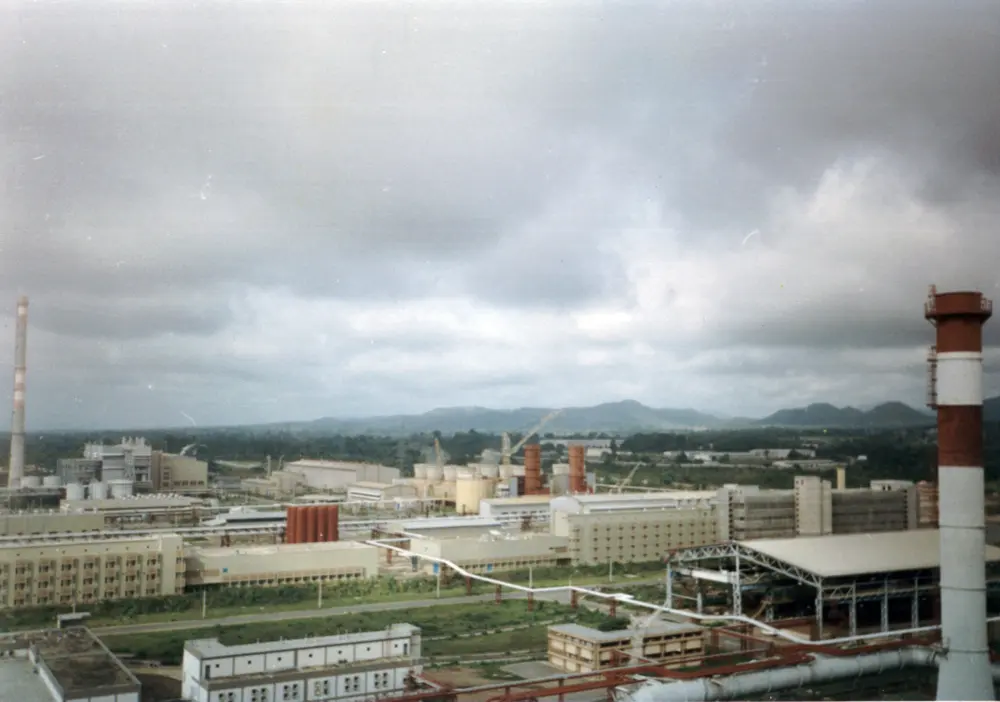
Lost history · 1979 to present
Image: Ajaokuta-factory.JPG — Ilya Volkov, Public domain · source
Thirteen villages gave up their land for a Soviet-built steel giant on the Niger. Nearly fifty years on, the town is still waiting for the steel.
Mustapha Ayenugba remembers the steel plant from the inside. As a secondary school boy he got a holiday job there. Later he joined properly and stayed until he retired in 2004. Today he is the traditional ruler of Ajaokuta, and when Weekend Trust reporters came to see him in 2024, he started the story with his father. His late father was the ruler in 1979, when the project arrived. The federal government took about 24,000 hectares for it, land that covered thirteen communities, Ajaokuta and Geregu among them. Ayenugba said his forefathers gave it up gladly. His people were mostly farmers and fishermen on the Niger, and they believed the plant would bring jobs and business into every compound. For a while it did. Ayenugba described the town as a beehive. Landlords filled their rooms. Petty traders, hotel owners, farmers and fishermen all had customers. The bustle, he said, was a sight to behold. But the land never came back. He complained that his people lost the title to their ancestral farms, while neighbours over in the Itobe axis can still sell plots to buyers when times are hard. The plant itself sits on about 800 hectares, the company says. So when the works went quiet, the people of Ajaokuta had neither the farms they gave away nor the jobs they were promised. That is where this story really begins, in a river town that bet everything on one thing.
The big idea was simple enough. Nigeria wanted to make its own steel instead of shipping it in. In 1971 the government set up the Nigerian Steel Development Authority. Two years later geologists found commercial iron ore at Itakpe, Ajabanoko and Oshokoshoko, all in what is now Kogi State. British experts did an early study, then the Soviet Union took over the work. In 1979, under President Shehu Shagari, Ajaokuta Steel Company was created, and the Soviet-built complex began to rise beside the river. Even the start date is argued over. The company dates its global construction contract to 1979, while a 2026 piece in TheCable says the first contract was signed in 1976 for a billion dollars. The figures for size differ too. The company says the first stage was built for 1.3 million tonnes of steel a year, with room to grow to 5.2 million. TheCable puts the design at three million. Either way, this was not one factory but a whole chain: a blast furnace, oxygen furnaces, four rolling mills, a 110-megawatt power plant and an engineering workshop for spare parts. The company said it would employ about 10,000 people directly and help create work for half a million more. By 1994 the company counted 98 per cent of its equipment in place, with 40 of 43 plants built. That sounds like the last mile. It wasn't. The Russian partners left, and the union chairman, Salifu Idowu Adinoyi, told Weekend Trust that between 1994 and 2005 almost nothing happened except routine maintenance. A retired engineer, B. Raphael, said the plant collapsed in 1994 under a conspiracy of interest groups at home and abroad. He also told a strange story about a head of state of that era who wanted the flat-sheet mill pulled out and set up in his own home state, until the engineers talked him out of it.
Then came the rescuers. Wikipedia records a Japanese concession in 2002, and then an Indian-backed company, Global Infrastructure Holdings, which took over around 2004 or 2005. The government threw it out in 2008, accusing it of stripping assets, and the fight went to arbitration. Nigeria got the plant back in 2016 and agreed in 2022 to pay $496 million to settle the claims. Has the plant ever rolled steel? It depends who you ask. The company says rolling began in November 2004. Wikipedia says only the light mills went into use, in 2018, for iron rods and small fabrication. At a Senate hearing, Senator Natasha Akpoti-Uduaghan said flatly that no mill had rolled. What everyone agrees on is that the blast furnace, the heart of the place, has never made steel. Experts quoted by Weekend Trust point to a hard problem underneath it all. Nigeria's ore is low grade, under 40 per cent iron, and has to be upgraded or blended with imported ore before it can feed a furnace like this. That needs working mines, a working railway and a port, all at once. Meanwhile the bill keeps coming. Estimates of total spending run from eight billion dollars to more than ten. TheCable quotes Paul Unongo, once steel minister, calling Ajaokuta a drainpipe for the ruling party of the early 1980s. The 2026 budget gives the company N6.69 billion, and N6.04 billion of that is for staff, Punch reported. Yet Akpoti-Uduaghan said that on her visits she hardly saw ten people at work. Adinoyi counted 1,627 workers in July 2024, down from almost 10,000 at the peak, and a source told the paper that more than 400 had died without their families receiving the N200,000 burial grant. When the reporters walked the site, weeds had swallowed the old transport yard and the metallurgical training school. Nigeria still imports about 70 per cent of its steel, around four billion dollars a year. And in the town by the river, people are still waiting for the steel their fathers gave up their land for.